Why You Need Protein
Protein
You body is around 20% protein depending on your age and fitness level. Proteins hold our skin, tendons and muscles together and catalyzes the chemical reactions that allow us to live.
While plants can make their own protein (and pull carbon out of the air to make sugars - show-offs), we cannot make some proteins. So we have to eat protein from plant and/or animal sources.
Protein is healthy and safe
You are designed to eat protein which is why many people crave it. Eating normal amounts of animal and/or plant protein does not cause higher risks of dying from all-causes, cardiovascular disease, or cancer. In fact, this large study (15,937 women and men) showed that eating animal protein may be mildly protective against cancer mortality (Papanikolaou et al. 2025).
How much protein do you need?
According to the latest research: for optimal health adults need between 1.1 and 2.0 g protein per kg of body weight (bw) a day (or 0.5-0.9 g protein/lb/bw). This is more than the current DRI.
Are you a younger adult? You are better at metabolizing protein and can do well on the lower end of the range.
Are you an older person? You need more protein and should aim for 1.2-1.5 g protein/kg/bw.
Do you have a metabolic disorder, overall inflammation, or any other chronic illness? You need the most protein. Chronically ill people need as much as 2.0 g/protein/kg/bw.
Why is this recommendation higher than the current DRI for protein?
The current recommendations for protein are too low. Protein requirements are designed to prevent protein deficiencies not to encourage robust good health. To see why the current protein DRI is incorrect, check out our webpage on how much protein you need.
The current Protein Dietary Reference Intake (DRI) recommendation for adults is 0.8 grams per kg of body weight a day (0.36 g protein/lb/bw). Thus, a 150 pound person would need 54 grams of protein a day.
New research suggests that healthy adults need 40% more protein than the current DRI or 1.12 g protein/kg/bw. According to this a 150 pound person would actually need 81 grams of protein a day. Likewise, children (4-13 years) may require up to 60% more protein than the current RDA recommendations (discussion Weiler et al. 2020).
Gordon Park - Couple eating dinner at their home in Washington DC 1942.
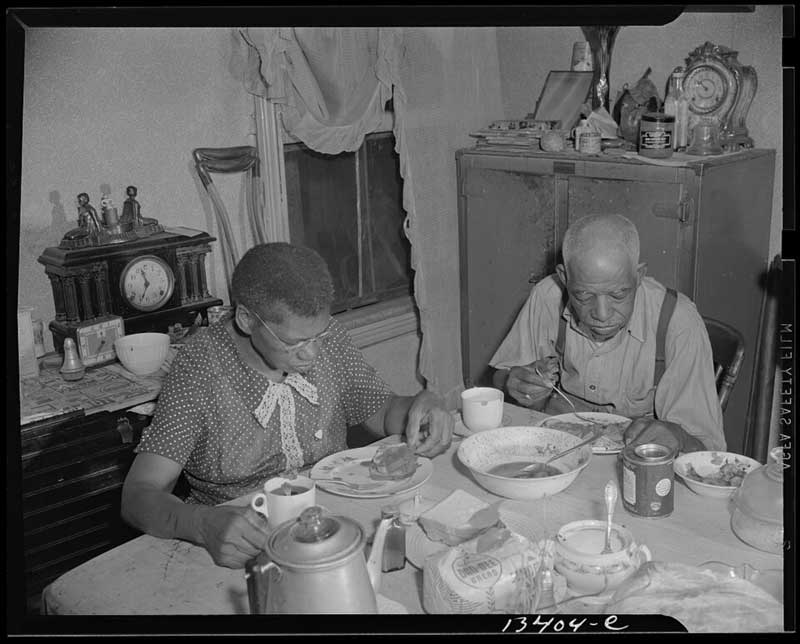
People who are older, sick or injured need MORE protein than healthy people.
A conservative estimation is that older adults need between 1.1 g and 1.2 g protein/kg/bw to improve muscle protein synthesis (MPS) and maintain lean body mass. Many researchers believe it should be even higher at 1.2-1.5 g protein/kg/bw (discussion Harris et al. 2025).
Seniors who have chronic disease(s), malnutrition, acute illness, risks for frailty, and/or other inflammatory conditions, need to increase their dietary protein to between 1.2 and 1.5 g protein/kg/bw. People with severe illnesses or risk factors may need a higher protein intake, up to 2.0 g protein/kg/bw, to support immune function (discussion Harris et al. 2025). In this case, a 150 pound chronically ill senior would need 136 grams protein a day.
Protein Facts
✤ Older people need to eat more protein than younger ones
✤ You should eat least 20-35 grams protein per meal
✤ Strength (resistance) exercises plus protein increases muscle synthesis
✤ Essential amino acids drive muscle growth
Air Force Wounded Warrior Trials 2014 by Staff Sgt. Nadine Barclay.

Everyone should eat at least 20-35 grams protein a meal
Recent research has suggested that people aim for a per meal protein requirement instead of a daily protein requirement (discussion Weiler et al. 2023).
Muscle protein breakdown and muscle protein synthesis (building) rates are highly responsive to both food intake, particularly protein intake, and to physical activity. How much protein per meal you need to eat to optimize postprandial MPS depends on age, the essential amino acid content of the protein (especially leucine which stimulates muscle protein synthesis), and whether or not you are doing strength training (resistance training).
Seniors need to eat more protein in a meal
As you age you need more protein. Sadly, most people eat less protein as they get older.
Healthy older men (48 men, average age 66 years old) consumed either 0, 15, 30, or 45 grams of milk protein concentrate after resistance exercise (leg press, leg extension, lat pulldowns, and chest press). Thirty grams of milk concentrate protein is around 1/3 cup. Ingestion of greater than 30 g milk protein after exercise increased muscle (myofibrillar) protein synthesis rates in the men (Holwerda et al. 2019).
Younger athletes benefit from eating more protein per meal
Young endurance trained cyclists and triathletes (48 men, average age 27 years) consumed a drink with 45 grams carbohydrates (dextrose and maltodextrin) and either 0, 15, 30, or 45 g of milk protein after a session of endurance exercise. Mitochondrial protein synthesis (MitoPS) was optimally stimulated by 30 grams of protein.
MitoPS (sounds like a kpop group) increased by 46% after drinking 30 grams of protein when compared to drinking zero protein. Both whole-body net protein balance and dietary protein-derived amino acid incorporation into mitochondrial protein reacted to increasing milk protein intake in a dose-dependent manner (Churchward-Venne et al. 2020).
Your body needs a surplus of protein to make the so-called nonessential amino acids
People can make some nonessential amino acids but they need adequate protein to do so (Weiler et al. 2020). Current research indicate that neither animals or humans can adequately synthesize enough nonessential amino acids to meet ideal metabolic and functional needs under either stress OR normal conditions (Hou and Wu 2017). This means you need to get them in your diet.
Nonessential and conditionally essential amino acids have been unfairly named; they are not actually nonessential. These amino acids are used for many functions including neurotransmission; folate conversion in one carbon metabolism; activating cell signaling pathways, renal regulation of acid/base balance; antioxidant reactions in organs and muscle; and making glutathione, nucleotides, dopamine, creatine, melanin, thyroid hormones, serotonin and more (see Hou and Wu 2017 for more details).
Recent research indicates that animals have defined dietary requirements of nonessential and conditionally essential amino acids to optimize their genetic potential for peak health and well-being (Hou and Wu 2017).
Kusakabe Kimbei - 194 Eating. Dinner before 1933 hand tinted albumen prnt.
There are twenty amino acids used in the human body:
✤ Nine essential amino acids (AAs): histidine, isoleucine, leucine, lysine, methionine, phenylalanine, threonine, tryptophan, and valine
✤ Six conditionally essential AAs: arginine, cysteine, glutamine, glycine, proline, and tyrosine
✤ Five nonessential AAs: alanine, aspartic acid, asparagine, glutamic acid, and serine
Remember: so called nonessential and conditionally essential amino acids are actually needed.
Want to build muscle? Eat 25-35 grams of protein 2-3 times a day
Meeting optimal per meal protein intakes (in most cases 25-35 grams protein) results in maximal postprandial muscle protein synthesis (MPS) in adults of all ages. MPS is when the body builds the proteins for muscles after a meal.
In a 7-d crossover feeding design, healthy women and men (average age 37 years) who consumed 30 grams of protein in three spaced meals had 25% more muscle protein synthesis (MPS) than when they consumed the same amount of protein in a skewed pattern (11 g for breakfast, 16 g for lunch, and 63 g for dinner). Eating 30 grams of protein for three meals increased MPS by 1/4 (Mamerow et al. 2014).
Young men (average age 20 years) who redistributed their protein intake to include more protein at breakfast and less at dinner had a tendency to gain more lean tissue mass (2.5 kg) than the ones with a more typical lower protein breakfast (1.8 kg) (Yasuda et al. 2020).
In a similar line, 60 healthy older women and men (mean age 61 years old) either received a milk based protein supplement (0.165 g/kg body mass) or a maltodextrin control with the same caloric count at breakfast and lunch. Basically a 150 lb person would be given an extra 11 gram protein for breakfast and lunch. Consuming the protein supplement for 24 wk increased lean tissue mass by 0.6 kg compared to the maltodextrin control (Norton et al. 2016).
Motivate yourself to exercise using these tips!
By Susan Fluegel PHD Nutritional Biochemistry and Lori Wood MS Human Nutrition.
* People and their stories are real, but their names and some small identifying details are changed.
This information in this website is for informational purposes only and does not constitute medical advice, diagnosis, or treatment.
References:
Blomstrand E. A role for branched-chain amino acids in reducing central fatigue. J Nutr. 2006 Feb;136(2):544S-547S. doi: 10.1093/jn/136.2.544S. Full article.
Burd NA, McKenna CF, Salvador AF, Paulussen KJM, Moore DR. Dietary Protein Quantity, Quality, and Exercise Are Key to Healthy Living: A Muscle-Centric Perspective Across the Lifespan. Front Nutr. 2019 Jun 6;6:83. doi: 10.3389/fnut.2019.00083. Full article.
Campbell WW, Trappe TA, Wolfe RR, Evans WJ. The recommended dietary allowance for protein may not be adequate for older people to maintain skeletal muscle. J Gerontol A Biol Sci Med Sci. 2001 Jun;56(6):M373-80. doi: 10.1093/gerona/56.6.m373. Abstract.
Churchward-Venne TA, Pinckaers PJM, Smeets JSJ, Betz MW, Senden JM, Goessens JPB, Gijsen AP, Rollo I, Verdijk LB, van Loon LJC. Dose-response effects of dietary protein on muscle protein synthesis during recovery from endurance exercise in young men: a double-blind randomized trial. Am J Clin Nutr. 2020 Aug 1;112(2):303-317. doi: 10.1093/ajcn/nqaa073. Full article.
Coelho-Junior HJ, Marzetti E, Picca A, Cesari M, Uchida MC, Calvani R. Protein Intake and Frailty: A Matter of Quantity, Quality, and Timing. Nutrients. 2020 Sep 23;12(10):2915. doi: 10.3390/nu12102915. Full article.
Dimou A, Tsimihodimos V, Bairaktari E. The Critical Role of the Branched Chain Amino Acids (BCAAs) Catabolism-Regulating Enzymes, Branched-Chain Aminotransferase (BCAT) and Branched-Chain α-Keto Acid Dehydrogenase (BCKD), in Human Pathophysiology. Int J Mol Sci. 2022 Apr 5;23(7):4022. doi: 10.3390/ijms23074022. Full article.
Elango R, Humayun MA, Ball RO, Pencharz PB. Evidence that protein requirements have been significantly underestimated. Curr Opin Clin Nutr Metab Care. 2010 Jan;13(1):52-7. doi: 10.1097/MCO.0b013e328332f9b7. Full pdf.
Francis P, Mc Cormack W, Toomey C, Norton C, Saunders J, Kerin E, Lyons M, Jakeman P. Twelve weeks' progressive resistance training combined with protein supplementation beyond habitual intakes increases upper leg lean tissue mass, muscle strength and extended gait speed in healthy older women. Biogerontology. 2017 Dec;18(6):881-891. doi: 10.1007/s10522-016-9671-7. Full article.
Harris S, DePalma J, Barkoukis H. Protein and Aging: Practicalities and Practice. Nutrients. 2025 Jul 28;17(15):2461. doi: 10.3390/nu17152461. Full article.
Holwerda AM, Paulussen KJM, Overkamp M, Goessens JPB, Kramer IF, Wodzig WKWH, Verdijk LB, van Loon LJC. Dose-Dependent Increases in Whole-Body Net Protein Balance and Dietary Protein-Derived Amino Acid Incorporation into Myofibrillar Protein During Recovery from Resistance Exercise in Older Men. J Nutr. 2019 Feb 1;149(2):221-230. doi: 10.1093/jn/nxy263. Full article.
Hou Y, Wu G. Nutritionally Nonessential Amino Acids: A Misnomer in Nutritional Sciences. Adv Nutr. 2017 Jan 17;8(1):137-139. doi: 10.3945/an.116.012971. Full article.
Jonker R, Deutz NE, Erbland ML, Anderson PJ, Engelen MP. Effectiveness of essential amino acid supplementation in stimulating whole body net protein anabolism is comparable between COPD patients and healthy older adults. Metabolism. 2017 Apr;69:120-129. doi: 10.1016/j.metabol.2016.12.010. Full article.
Mamerow MM, Mettler JA, English KL, Casperson SL, Arentson-Lantz E, Sheffield-Moore M, Layman DK, Paddon-Jones D. Dietary protein distribution positively influences 24-h muscle protein synthesis in healthy adults. J Nutr. 2014 Jun;144(6):876-80. doi: 10.3945/jn.113.185280. Full article.
Markofski MM, Jennings K, Timmerman KL, Dickinson JM, Fry CS, Borack MS, Reidy PT, Deer RR, Randolph A, Rasmussen BB, Volpi E. Effect of Aerobic Exercise Training and Essential Amino Acid Supplementation for 24 Weeks on Physical Function, Body Composition, and Muscle Metabolism in Healthy, Independent Older Adults: A Randomized Clinical Trial. J Gerontol A Biol Sci Med Sci. 2019 Sep 15;74(10):1598-1604. doi: 10.1093/gerona/gly109. Full article.
Morris R, Black KA, Stollar EJ. Uncovering protein function: from classification to complexes. Essays Biochem. 2022 Aug 10;66(3):255-285. doi: 10.1042/EBC20200108. Full article.
Norton C, Toomey C, McCormack WG, Francis P, Saunders J, Kerin E, Jakeman P. Protein Supplementation at Breakfast and Lunch for 24 Weeks beyond Habitual Intakes Increases Whole-Body Lean Tissue Mass in Healthy Older Adults. J Nutr. 2016 Jan;146(1):65-9. doi: 10.3945/jn.115.219022. Full article.
Panwar V, Singh A, Bhatt M, Tonk RK, Azizov S, Raza AS, Sengupta S, Kumar D, Garg M. Multifaceted role of mTOR (mammalian target of rapamycin) signaling pathway in human health and disease. Signal Transduct Target Ther. 2023 Oct 2;8(1):375. doi: 10.1038/s41392-023-01608-z. Full article.
Papanikolaou Y, Phillips S, Fulgoni V 3rd. Animal and plant protein usual intakes are not adversely associated with all-cause, cardiovascular disease-, or cancer-related mortality risk: an NHANES III analysis. Appl Physiol Nutr Metab. 2025 Jan 1;50:1-8. doi: 10.1139/apnm-2023-0594. Full article.
Wall BT, Gorissen SH, Pennings B, Koopman R, Groen BB, Verdijk LB, van Loon LJ. Aging Is Accompanied by a Blunted Muscle Protein Synthetic Response to Protein Ingestion. PLoS One. 2015 Nov 4;10(11):e0140903. doi: 10.1371/journal.pone.0140903. Full article.
Weiler M, Hertzler SR, Dvoretskiy S. Is It Time to Reconsider the U.S. Recommendations for Dietary Protein and Amino Acid Intake? Nutrients. 2023 Feb 6;15(4):838. doi: 10.3390/nu15040838. Full article.
Yasuda J, Tomita T, Arimitsu T, Fujita S. Evenly Distributed Protein Intake over 3 Meals Augments Resistance Exercise-Induced Muscle Hypertrophy in Healthy Young Men. J Nutr. 2020 Jul 1;150(7):1845-1851. doi: 10.1093/jn/nxaa101. Full article.