Healing With Art
Art promotes good health
When you look at or create art you are nourishing health. Over 3,000 studies show that the arts prevent poor health, promote good health, and help manage and treat illnesses throughout life (Fancourt and Finn 2019).
Hana M: "When I create art, I enter a state of intense playfulness and joy. Creating art to me is play. I enjoy the textures, shapes and colors. I love experimenting with new techniques. It is experimentation and fun."
Why is art healing?
Do you ever wonder how much a cloud weighs, what your cat thinks about you, or how many neurons it takes to save a memory?
People are made to be curious about the world around them. You are designed to play and daydream. You are designed to think logically. You are designed to create, invent and build.
Creativity is the intersection of spontaneous mind wandering (daydreaming) and play combined with structured and logical thought. The act of creating or being creative strengthens core areas of your brain.
In addition, art is made of strong sensory inputs that engage many interconnected neural pathways.
Art heals your brain and your body.
Mykhail N (33 years old): "I find art healing. Producing something, grounds me. You don't need to be an ARTIST in capital letters to process trauma through art.
When I find myself overwhelmed by memories I put it down on paper. I draw, I scribble, I write words; I don't care how bad it looks. It helps me process my pain and I feel better."
What is art?
The boundaries of art are fluid.
Art is something that uses both active and receptive engagement; transcends cultural boundaries; and contain the flexibility to allow new art forms to evolve.
Use art to reduce stress
Making art for 45 minutes using collage materials, modeling clay, and/or markers significantly lowered cortisol levels in 75% of participants (Kaimal et al. 2016).
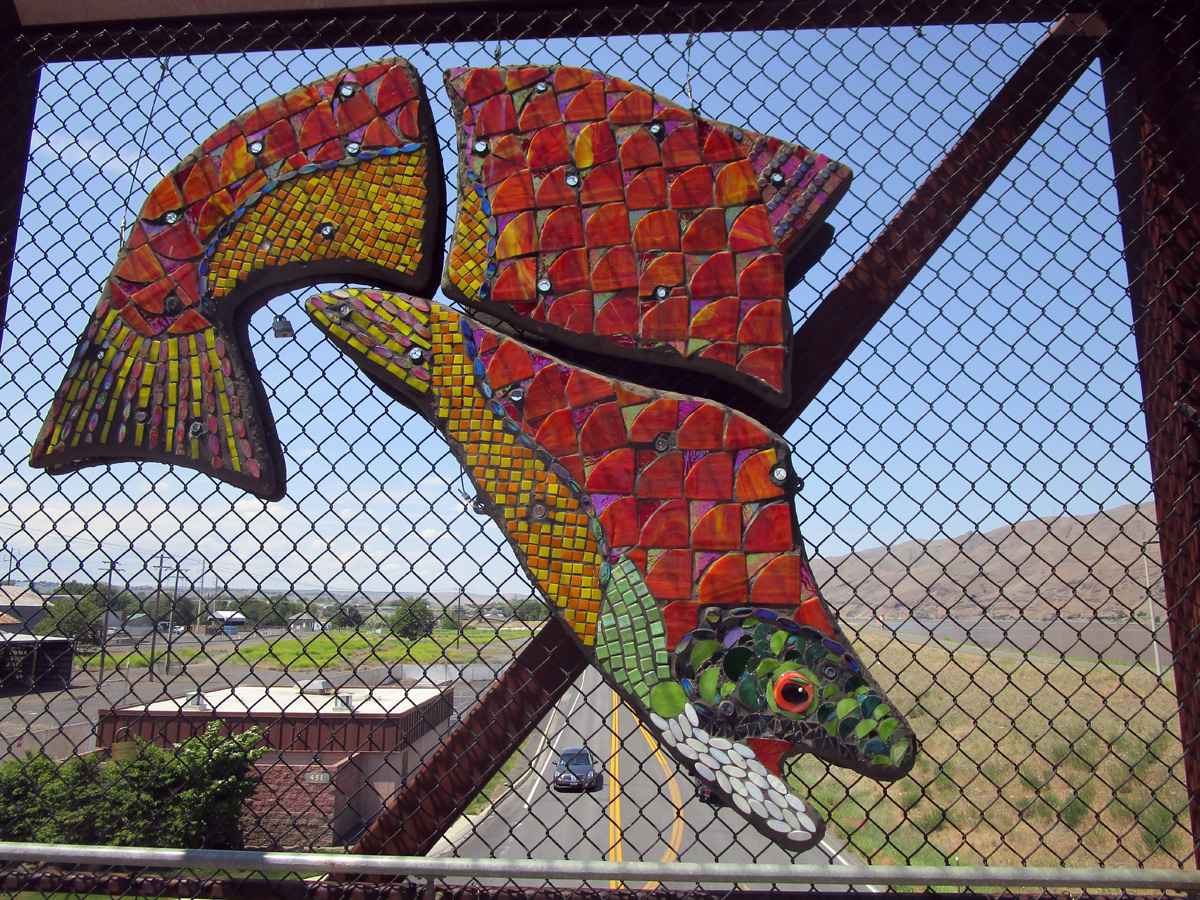
Art below: fish detail from 'Confluence' 2012 concrete with glass mosaic and epoxy grout by Melissa Cole. On 5th Street pedestrian bridge in Lewiston, ID.
Art forms include:
✽ Visual arts, design, craft (drawing, crafting, designing, painting, sculpture, pyrography, glassblowing, photography, collage, floral design, print making, origami, ice sculpting, textiles)
✽ Performing arts (music, singing, dance, puppet shows, slam poetry, theater, film, speeches, street arts like graffiti)
✽ Wearable art (textiles, embroidery, tapestry, jewelry making, fashion design)
✽ Practical arts (architecture, ceramics, culinary, graphic design, mosaic, basket weaving, quilt making, woodworking, bookbinding, metalworking)
✽ Literature (reading, writing, comics, manga, calligraphy, literary fairs)
✽ Online, electronic and other digital arts (film-making, animations, and computer graphics)
✽ Body art (tattoos, piercing, scarification)
✽ Culture (going to galleries, museums, art exhibitions, the theatre, concerts, community events, cultural festivals and fairs)
✽ Interactive community art (painted rocks to leave around your community, yarn bombings, sidewalk art and more)
Feeling stagnant? Check out some art.
A review of 38 studies (6,805 women and men) found that viewing works of art improved eudemonic wellbeing (Trupp et al. 2025). Eudemonic wellbeing is connected to finding meaning in life and personal growth. The art included in the study was visual objects or images such as paintings, sculptures, drawings, photography, installations, mixed-media and more. It could be present anywhere from an art museum to a hospital waiting room. It include classical as well as modern art.
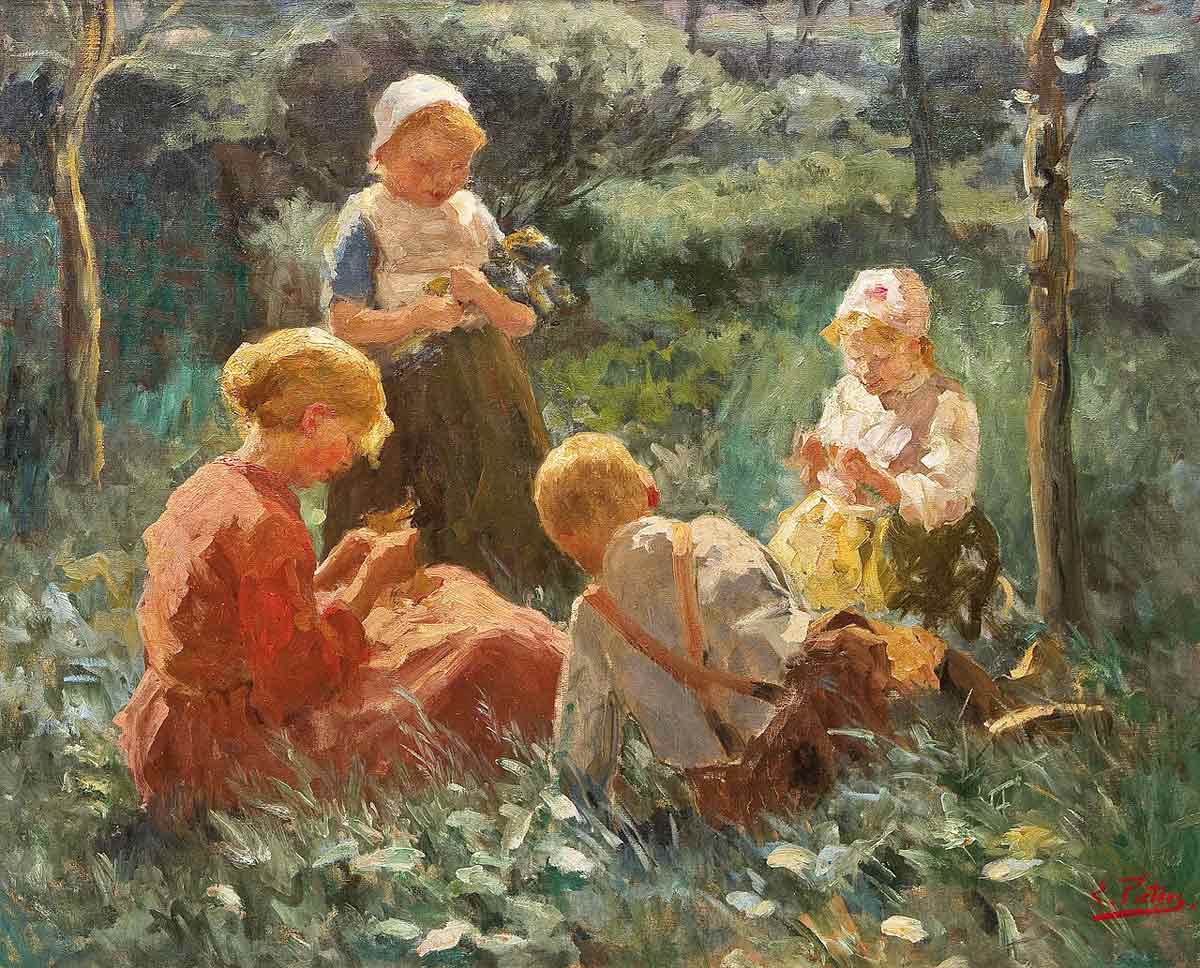
Evert Pieters Spielende Kinder im Grünen (children making flower chains) c1910 oil on canvas.
Doodle therapy
Making art activates the reward center of the brain.
Researchers measured brain activation using functional near-infrared spectroscopy (fNIRS) during the three different drawing tasks—coloring, doodling, and free drawing. Functional near-infrared spectroscopy (fNIRS) measures oxygenated blood flow to different areas of the brain. It basically shows what parts of the brain require more oxygen.
Coloring a mandala, doodling around a premarked circle, and free drawing all activated the brain's medial prefrontal cortex when compared to resting with eyes closed. After making art, people in the study improved their self-perceptions of problem solving and whether they had good ideas. (Kaimal et al. 2017).
The medial prefrontal cortex (PFC) processes higher cognitive skills in order to perform crucial executive functions, like planning, reasoning, language, and social interactions. It releases dopamine, noradrenaline and serotonin (Jobson et al. 2021)
One large medial prefrontal cortex network is the default mode network (DMN). The DMN is distributed across several areas in the PFC as well as the posterior cingulate cortex (PCC).
The DMN seems to be the brain's resting state. It is involved in abstract cognition, such as day dreaming, self-referential thoughts, reminiscing about the past, and future planning.

Blue Box of Science:
Brain hemispheres are plastic
Your brain can heal due to its incredible ability to regenerate.
Your brain has two halves or hemispheres. Each half controls the opposite side of the body (contralateral). The right side of the brain is connected to the motor and sensory nerves that control the left side of the body and vice versa. Brains are lateralized, each side or hemisphere specializes in processing different information, or unique specific behaviors.
Normally tasks get divided between the two halves. Your brain is incredibly adaptive though. People have lived normal lives with just one half of their brain, with the two halves disconnected, or with large areas of their brain damaged.
Some children with severe epilepsy have a hemispherotomy, where the two brain halves are disconnected so they do not communicate or a hemispherectomy, which removes damaged brain parts. This is done to remove or isolate the damaged part of the brain causing seizures. If the child is young enough the whole brain can rewire itself and retain normal function.
Adult brains also have much more plasticity than people previously believed. A small study of 6 adults with childhood hemispherectomies found that brain organization was conserved in the intact brain hemisphere. However, communication between functional networks within the hemisphere was greatly increased compared to people with both brain halves intact. In addition, the left hemisphere speech-related brain areas such as Broca's or Wernicke's area were relocated to the right brain in people with a missing left hemisphere (Kliemann et al. 2019).
The remarkable ability of the brain to compensate is due to the redundant (extra) systems present in the brain as well as neuronal plasticity; the brain's tremendous ability to be flexible and adapt. People who have brain damage due to Long COVID, head injuries, concessions, PTSD and other causes can heal their brains due to this incredible adaptability.
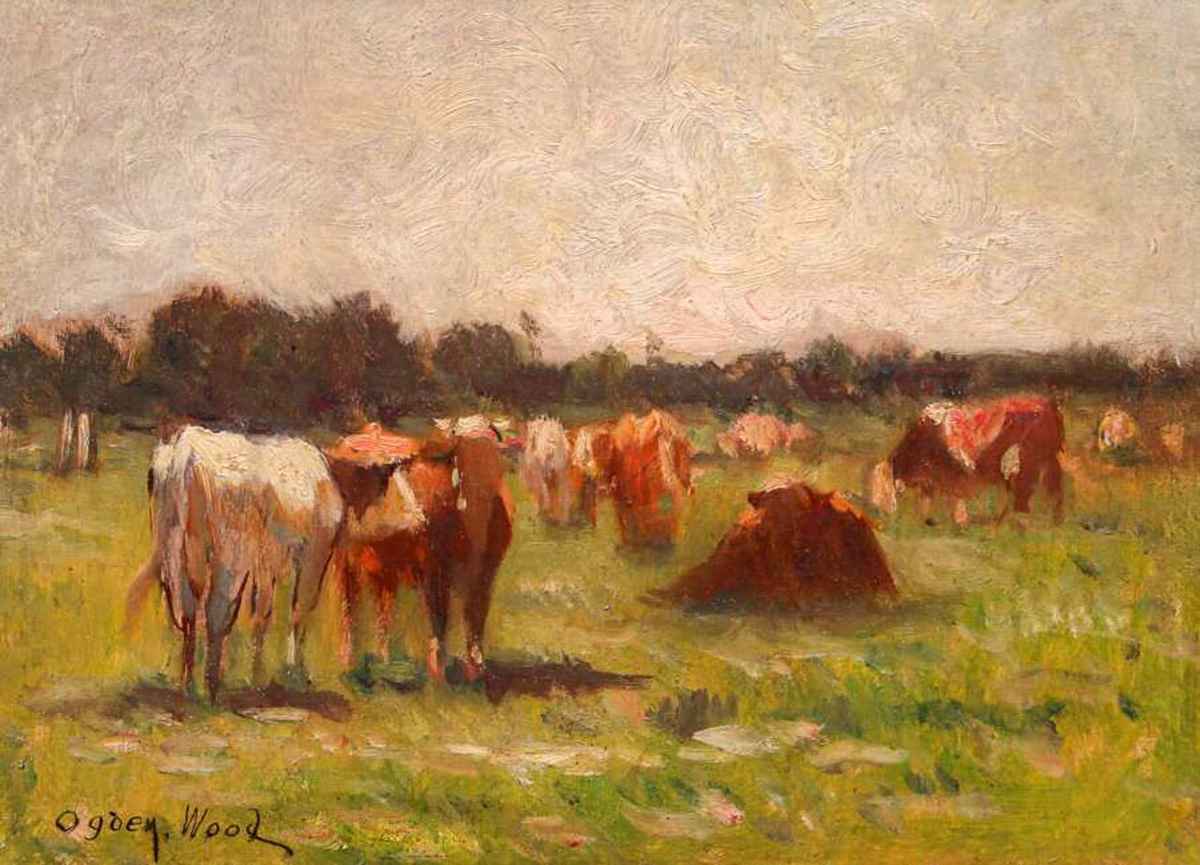
Painting below: Ogden Wood Cows Resting c1900.
Anyone can make art
Do you know any young kids that are afraid to pick up a marker or crayon and start drawing (sometimes on things you wish they wouldn't - like the walls)? I don't. Channel your kid energy and start creating yourself.
Start with fun colorful and textile stuff: colorful paint pens, 3D acrylics, bright colored clay, or that wood burner set you always wanted as a kid (just be careful).
Do stuff you weren't supposed to do as a kid: make a wall mural, super glue your colorful cereal into a abstract bird sculpture, paint your landscape boulders with faces, hang 3D art from your tree or whatever makes you happy.
Angry? Tap into your inner Banksy and make some activist art.
Having problems getting started with art? Here's some advice:
Mariola G "If you are having problems starting a project, think like a child. Become the six year old making a butterfly out of discarded colored plastic and play with whatever is around you. Use nature and found objects; sticks, leaves, stones, snow and other on site objects to create works of art."
Conley J "Sometimes, all it takes to let lose and create is to forget your preconceived expectation of art."
What is color?
Color has energy and frequency. Our eyes and brain respond to both.
Red has the longest wavelength (frequency) and least energy.
Violet has the shortest wavelength and highest energy.
We can see over 10 million colors.
Color is made of hue, saturation and lightness.
Our response to color is highly cultural.
Itō Jakuchū - Black rooster and nandin (Colorful Realm of Living Beings)c1761-1765.
-{{PD-US-expired}}.jpg)
Color therapy
Veterans (84 men with PTSD) either colored madala designs or free colored squares twice a week for three weeks. Happiness scores significantly increased in all the men after three weeks of coloring. Men who colored the mandalas were significantly more happy than those in the free coloring group (Nasiri et al. 2024).
Drawing and coloring patterns allows people to become more aware of their feelings and thoughts. It also allows them to focus their attention on the present moment and be more grounded. This improves mindfulness and emotional self-regulation which reduces anxiety.
By Susan Fluegel PHD Nutritional Biochemistry
*Names and some minor identifying details in all stories in this website are changed to protect people's privacy.
This information in this website is for informational purposes only and does not constitute medical advice, diagnosis, or treatment.
References:
Fancourt D, Finn S. What is the evidence on the role of the arts in improving health and well-being? A scoping review [Internet]. Copenhagen: WHO Regional Office for Europe; 2019. Full article.
Jobson DD, Hase Y, Clarkson AN, Kalaria RN. The role of the medial prefrontal cortex in cognition, ageing and dementia. Brain Commun. 2021 Jun 11;3(3):fcab125. doi: 10.1093/braincomms/fcab125. Full article.
Johnson-Laird PN, Oatley K. How poetry evokes emotions. Acta Psychol (Amst). 2022 Apr;224:103506. doi: 10.1016/j.actpsy.2022.103506. Full article.
Kaimal G, Hasan Ayaz, Joanna Herres, Rebekka Dieterich-Hartwell, Bindal Makwana, Donna H. Kaiser, Jennifer A. Nasser. Functional near-infrared spectroscopy assessment of reward perception based on visual self-expression: Coloring, doodling, and free drawing. The Arts in Psychotherapy, 2017; 55: 85 DOI: 10.1016/j.aip.2017.05.004. Summary.
Kaimal G, Ray K, Muniz J. Reduction of Cortisol Levels and Participants' Responses Following Art Making. Art Ther (Alex). 2016 Apr 2;33(2):74-80. doi: 10.1080/07421656.2016.1166832. Full article.
Kliemann D, Adolphs R, Tyszka JM, Fischl B, Yeo BTT, Nair R, Dubois J, Paul LK (2019) Intrinsic Functional Connectivity of the Brain in Adults with a Single Cerebral Hemisphere. Cell Rep 29(8): 2398-2407. doi 10.1016/j.celrep.2019.10.067 Full article.
Nasiri MA, Sajadi SA, Farsi Z, Heidarieh M. The effect of mandala coloring and free coloring on the happiness in veterans with post-traumatic stress disorder in the Covid-19 pandemic: a randomized clinical trial. BMC Psychiatry. 2024 Jun 25;24(1):467. doi: 10.1186/s12888-024-05886-x. Full article.
Trupp, MD, Howlin C, Fekete A, Kutsche J, Fingerhut J & Pelowski M. (2025). The impact of viewing art on well-being—a systematic review of the evidence base and suggested mechanisms. The Journal of Positive Psychology, 20(6), 978–1002. https://doi.org/10.1080/17439760.2025.2481041 Full article.