Long COVID Symptoms
Long COVID can negatively influence almost every part of your body and mind.
There are different subtypes of Long COVID.
General symptoms (these are most commonly reported problems):
★ Tiredness or deep down fatigue that interferes with daily life and everyday chores.
Around 53-87% of Long COVID patients reported fatigue (Klein et al. 2022, Perlis et al. 2022). People with long COVID had a moderate to severe impairment in doing everyday tasks compared to healthy people their age (Kedor et al.2022). Long COVID fatigue may be related to inflammation and/or hypoperfusion, which is reduced blood flow to an area. Long COVID may also impair energy metabolism.
★ Symptoms that get worse after physical or mental effort.
This is known as post-exertional malaise or post-exertional symptom exacerbation (PESE). This sounds like something a Victorian maiden would develop after a rousing game of lawn bowling but it is a serious condition.
Symptoms, including extreme exhaustion, typically develop 12-48 hours after the activity and can last for days or weeks. Other symptoms of Long COVID include exercise intolerance, pain, breathlessness, racing heart and sleep disorders.
★ Memory, critical thinking issues and/or confusion were reported in 46-78% of Long COVID patients (Klein et al. 2022, Perlis et al. 2022).
This may be due to inflammation and less blood flow to the brain. COVID-19 can damage the blood vessels in the brain which can start leaking. This damage is similar to that caused by strokes and neuroinflammatory diseases (Lee et al. 2020). In addition, antibodies generated to fight COVID-19 can attack cells that line the brain's blood vessels, leading to inflammation and damage (Lee et al. 2022).
★ Data collected by Cleveland Clinic’s Sleep Disorders Center, found that 40% of Long COVID patients reported moderate to severe sleep issues.
Black people have a higher incident of sleep disturbances.
★ Joint or muscle pain occurred in 18% of Long COVID patients (Durstenfeld et al. 2023).
Moldofsky et al. 2011 discusses this in a study of another post viral infection: post-SARS syndrome.
★ Fever or hot flushes that may alternate with chills or shivering occurred in 5% of people (Durstenfeld et al. 2023).
★ Loss of smell or taste occurred in 21-44% of people with Long COVID (Perlis et al. 2022, Durstenfeld et al. 2023).
A large study compared 1,487,712 women and men with a recorded diagnosis of COVID-19 with matched controls who caught a different repiratory illness over the span of 2 years. They found that risks of cognitive deficit such as brain fog, dementia, psychotic disorders, and epilepsy or seizures remained higher in people who had COVID (Taquet et al. 2022).
★ Overall, people who caught COVID-19 have a 3.8% chance of developing anxiety disorders and mood disorders (Coleman et al. 2022).
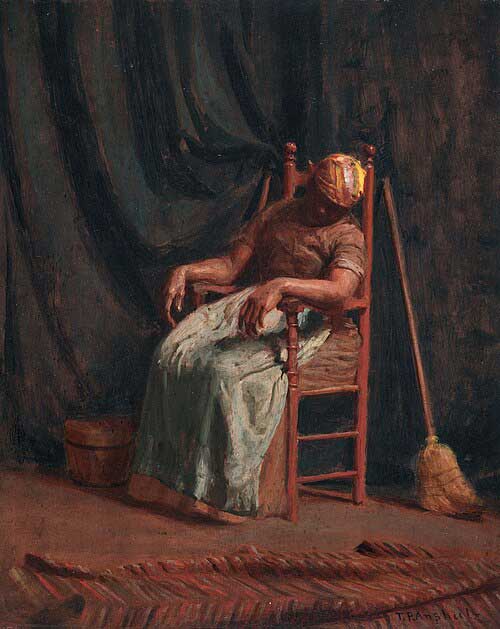
Painting: Thomas P. Anshutz - Aunt Hannah c1886.
Mark U. "I’m 41 and a dad. Can’t work full time anymore and even washing the dishes wears me out now. I used to play golf for 6 hours straight and now I’m lucky to hang out with friends for an hour a once a week before crashing hard. I also had the GI issues, but after 11 months that was resolved.
But 1.5 years on I’m still plagued with bone deep tireness and fatigue, post-exertional malaise, headaches, brain fog, etc. I’m continually hungry and have gained over 25 pounds. I get a dizzy feeling like my blood sugar is low and that signals me to eat to raise blood sugars, but eating doesn’t make me feel better. Eating usually makes me more exhausted."
Respiratory and cardiovascular symptoms in Long COVID
Do you have difficulty breathing, shortness of breath (dyspnea), abnormal breathing and/or feel like your lungs are constricted?
These symptoms occurred in 23-40% of Long COVID sufferers (Perlis et al. 2022, Durstenfeld et al. 2023, Xu et al. 2023) and can be due to lung damage and scarring.
★ Coughing and hacking.
★ Sour throat and/or hoarseness.
★ Chest pain.
Puntmann et al. 2022 reported that 60% of people who recovered from COVID-19 had signs of heart inflammation.
This can cause a fast-beating or pounding heart (also known as heart palpitations) and shortness of breath.
Postural orthostatic tachycardia syndrome (POTS) can adversely affect the involuntary nervous system functions, like heart rate, sweating and blood pressure.
Around 38% of people reported POTS in Klein's et al. 2022.
★ Increased incidence of blood clots along with blood vessel or vascular issues.
★ Pulmonary embolism where a blood clot from the deep veins of the legs travels to the lungs and blocks blood flow to the lungs (Varma et al. 2023).
★ Pulmonary fibrosis; a disease that causes scar tissue (fibrosis) to form in the lungs (Varma et al. 2023).
★ Edema (Varma et al. 2023).
Blue Box of Science:
Why COVID-19 causes food to taste funny
Some people have long term loss of taste after COVID-19. Most lose the ability to taste sweet, bitter or umami flavors. Salty and sour tastes remain unchanged.
Scientists analyzed taste receptor buds in the tongue of people with abnormal taste score. They found that their taste buds contained lower levels of a messenger RNA (mRNA) which codes for a protein known as PLCβ2. This protein amplifies and transmits taste signals for sweet, bitter, and umami flavors. Cells that taste sour and salty flavors do not use PLCβ2.
In addition, some people with altered taste had abnormal looking taste buds. They were not regenerating like normal (Morad et al. 2026).
Neurological symptoms in Long COVID
Difficulty thinking, concentrating, planning or making choices is sometimes referred to as brain fog and is characterized by a lack of mental clarity and cognitive dysfunction. It can cause confusion and memory issues and occurred in around 40% of Long COVID patients (Perlis et al. 2022).
★ Attention disorders found in 27% of people with Long COVID (Lopez-Leon et al. 2021).
★ Headaches were reported in 22-44% of Long COVID sufferers (discussion Umesh et al. 2022, Durstenfeld et al. 2023).
★ Sleep problems, insomnia and circadian rhythm disorders (when a person internal clock is not in sync with the environment). Sleep problems were reported by 32% of women and 23% of men (Perlis et al. 2022).
★ Dementia (Varma et al. 2023).
★ Dizziness when you stand up (light-headedness). Limbs falling asleep or pins-and-needles feelings.
★ Nerve pain or numbness.
★ Change in smell or taste was noted by 46% of women and 35% of men in Long COVID (Perlis et al. 2022, Trott et al. 2022). This includes either a complete or partial ability to taste and/or smell. It also includes phantosmia, in which the person smells an odor that really isn't there, and parosmia, in which a person smells strange, bad or sometimes unpleasant odors.
★ Depression or anxiety.
★ Post traumatic stress disorder develops in Long COVID (Lopez-Leon et al. 2021).
★ Hearing loss and/or tinnitus, a constant ringing in the ears.
★ Visual and eye disorders including blurring and digital eye strain (Trott et al. 2022).
Gastrointestinal disorders in Long COVID
★ Diarrhea (Xu et al. 2023).
★ Stomach and abdominal pain (Xu et al. 2023).
★ Vomiting, nausea and/or diarrhea was noted in 7% of people with Long COVID (Durstenfeld et al. 2023, Xu et al. 2023).
★ Constipation and motility disorders (Xu et al. 2023) .
★ Functional intestinal disorders (Xu et al. 2023).
★ Acid related disorders such as gastroesophageal reflux disease (GERD), dyspepsia, and peptic ulcer disease (Xu et al. 2023).
★ Acute pancreatitis (Xu et al. 2023).
★ Liver (hepatic) and biliary disease (Xu et al. 2023).
Menstrual cycle symptoms in Long COVID
★ Changes in menstrual cycles and bleeding (Al-Najjar et al. 2022).
★ This can include irregular periods,unusual clotting of period blood, or worse premenstrual syndrome (PMS) (Sharp et al. 2022).
★ COVID-19 may effect the hypothalamic-pituitary-ovarian-endometrial axis. This is the system that regulates women's hormone production, egg selection and uterine lining.
★ Changes in this system will influence the menstrual cycle (Sharp et al. 2022). Changes in blood volume or increased length of cycle (Lebar et al. 2022).
★ Aggravated PMS symptoms can also increase the levels of estrogen and progesterone in the body.
Unfortunately, questions about menstruation have been excluded from most large-scale COVID-19 studies (and most research studies in general). This points to the need to gather more information on women's health.
Léon Augustin Lhermitte (1844-1925), Resting in the Fields.

Other symptoms in Long COVID
★ Inflammation (Varma et al. 2023).
★ Dysautonomia, abnormalities in the autonomic nervous system disrupt heart rate, breathing, and digestive function.
★ Joint or muscle pain.
★ Loss of appetite.
★ Skin problems and rashes.
★ Kidney issues.
★ Sexual dysfunction.
★ Autoimmune disorders can occur in Long COVID.
★ Hair loss is reported in 20% of people post COVID (Nalbandian et al. 2022, Varma et al. 2023).
For a list of 203 symptoms people reported with Long COVID see chart at Davis et al. 2021.
Check out the cool diagram of all the ways Long COVID can screw you over at the RESULTS section of Varma et al. 2023. This large study included follow up data from 560,752 Black, White, Hispanic and Asian people (about 60% women) who had COVID-19.
By Susan Fluegel PHD Nutritional Biochemistry
*Names and some minor identifying details in all stories in this website are changed to protect people's privacy.
This information is for informational purposes only and does not constitute medical advice, diagnosis, or treatment.
References:
Al-Najjar MAA, Al-Alwany RR, Al-Rshoud FM, Abu-Farha RK, Zawiah M. Menstrual changes following COVID-19 infection: A cross-sectional study from Jordan and Iraq. PLoS One. 2022 Jun 29;17(6):e0270537. doi: 10.1371/journal.pone.0270537. Full article.
Bowe B, Xie Y, Al-Aly Z. Acute and postacute sequelae associated with SARS-CoV-2 reinfection. Nat Med. 2022 Nov;28(11):2398-2405. doi: 10.1038/s41591-022-02051-3. Epub 2022 Nov 10. Full article.
Clutterbuck D, Ramasawmy M, Pantelic M, Hayer J, Begum F, Faghy M, Nasir N, Causer B, Heightman M, Allsopp G, Wootton D, Khan MA, Hastie C, Jackson M, Rayner C, Brown D, Parrett E, Jones G, Clarke R, Mcfarland S, Gabbay M, Banerjee A, Alwan NA; STIMULATE-ICP Consortium. Barriers to healthcare access and experiences of stigma: Findings from a coproduced Long Covid case-finding study. Health Expect. 2024 Apr;27(2):e14037. doi: 10.1111/hex.14037. Full article.
Coleman B, Casiraghi E, Blau H, Chan L, Haendel MA, Laraway B, Callahan TJ, Deer RR, Wilkins KJ, Reese J, Robinson PN. Risk of new-onset psychiatric sequelae of COVID-19 in the early and late post-acute phase. World Psychiatry. 2022 Jun;21(2):319-320. doi: 10.1002/wps.20992. Full article.
Davis HE, Assaf GS, McCorkell L, Wei H, Low RJ, Re'em Y, Redfield S, Austin JP, Akrami A. Characterizing long COVID in an international cohort: 7 months of symptoms and their impact. EClinicalMedicine. 2021 Aug;38:101019. doi: 10.1016/j.eclinm.2021.101019. Full article.
Durstenfeld MS, Peluso MJ, Peyser ND, Lin F, Knight SJ, Djibo A, Khatib R, Kitzman H, O'Brien E, Williams N, Isasi C, Kornak J, Carton TW, Olgin JE, Pletcher MJ, Marcus GM, Beatty AL. Factors Associated With Long COVID Symptoms in an Online Cohort Study. Open Forum Infect Dis. 2023 Feb 1;10(2):ofad047. doi: 10.1093/ofid/ofad047. Full article.
Greenhalgh T, Manoj Sivan, Alice Perlowski, Janko Nikolich. Long COVID: a clinical update. The Lancet, 2024; doi: 10.1016/S0140-6736(24)01136-X. Full article.
Kedor C, Freitag H, Meyer-Arndt L, Wittke K, Hanitsch LG, Zoller T, Steinbeis F, Haffke M, Rudolf G, Heidecker B, Bobbert T, Spranger J, Volk HD, Skurk C, Konietschke F, Paul F, Behrends U, Bellmann-Strobl J, Scheibenbogen C. A prospective observational study of post-COVID-19 chronic fatigue syndrome following the first pandemic wave in Germany and biomarkers associated with symptom severity. Nat Commun. 2022 Aug 30;13(1):5104. doi: 10.1038/s41467-022-32507-6. Erratum in: Nat Commun. 2022 Oct 12;13(1):6009. Full article.
Lebar V, Lagan? AS, Chiantera V, Kunic T, Lukanovic D. The Effect of COVID-19 on the Menstrual Cycle: A Systematic Review. J Clin Med. 2022 Jun 30;11(13):3800. doi: 10.3390/jcm11133800. Full article.
Lee MH, Perl DP, Steiner J, Pasternack N, Li W, Maric D, Safavi F, Horkayne-Szakaly I, Jones R, Stram MN, Moncur JT, Hefti M, Folkerth RD, Nath A. Neurovascular injury with complement activation and inflammation in COVID-19. Brain. 2022 Jul 29;145(7):2555-2568. doi: 10.1093/brain/awac151. Full article.
Lee MH, Perl DP, Nair G, Li W, Maric D, Murray H, Dodd SJ, Koretsky AP, Watts JA, Cheung V, Masliah E, Horkayne-Szakaly I, Jones R, Stram MN, Moncur J, Hefti M, Folkerth RD, Nath A. Microvascular Injury in the Brains of Patients with Covid-19. N Engl J Med. 2021 Feb 4;384(5):481-483. doi: 10.1056/NEJMc2033369. Full article.
Lopez-Leon S, Wegman-Ostrosky T, Perelman C, Sepulveda R, Rebolledo PA, Cuapio A, Villapol S. More than 50 long-term effects of COVID-19: a systematic review and meta-analysis. Sci Rep. 2021 Aug 9;11(1):16144. doi: 10.1038/s41598-021-95565-8. Full article.
Moldofsky H, Patcai J. Chronic widespread musculoskeletal pain, fatigue, depression and disordered sleep in chronic post-SARS syndrome; a case-controlled study. BMC Neurol. 2011 Mar 24;11:37. doi: 10.1186/1471-2377-11-37. Full article.
Morad H, Vanhala T, Kisiel MA, Andreason A, Li M, Andersson G, Laurell G, Finger TE, Hellekant G. Taste dysfunction in Long COVID. bioRxiv [Preprint]. 2025 Nov 19:2025.07.17.661973. doi: 10.1101/2025.07.17.661973. Update in: Chem Senses. 2026 Mar 2;51:bjaf068. doi: 10.1093/chemse/bjaf068. Full article.
Nalbandian A, Sehgal K, Gupta A, Madhavan MV, McGroder C, Stevens JS, Cook JR, Nordvig AS, Shalev D, Sehrawat TS, Ahluwalia N, Bikdeli B, Dietz D, Der-Nigoghossian C, Liyanage-Don N, Rosner GF, Bernstein EJ, Mohan S, Beckley AA, Seres DS, Choueiri TK, Uriel N, Ausiello JC, Accili D, Freedberg DE, Baldwin M, Schwartz A, Brodie D, Garcia CK, Elkind MSV, Connors JM, Bilezikian JP, Landry DW, Wan EY. Post-acute COVID-19 syndrome. Nat Med. 2021 Apr;27(4):601-615. doi: 10.1038/s41591-021-01283-z. Full article.
Pantelic M, Ziauddeen N, Boyes M, O'Hara ME, Hastie C, Alwan NA. Long Covid stigma: Estimating burden and validating scale in a UK-based sample. PLoS One. 2022 Nov 23;17(11):e0277317. doi: 10.1371/journal.pone.0277317. Full article.
Perlis RH, Santillana M, Ognyanova K, Safarpour A, Lunz Trujillo K, Simonson MD, Green J, Quintana A, Druckman J, Baum MA, Lazer D. Prevalence and Correlates of Long COVID Symptoms Among US Adults. JAMA Netw Open. 2022 Oct 3;5(10):e2238804. doi: 10.1001/jamanetworkopen.2022.38804. Full article.
Perumal R, Shunmugam L, Naidoo K, Abdool Karim SS, Wilkins D, Garzino-Demo A, Brechot C, Parthasarathy S, Vahlne A, Nikolich J. Long COVID: a review and proposed visualization of the complexity of long COVID. Front Immunol. 2023 Apr 20;14:1117464. doi: 10.3389/fimmu.2023.1117464. Full article.
Puntmann VO, Carerj ML, Wieters I, Fahim M, Arendt C, Hoffmann J, Shchendrygina A, Escher F, Vasa-Nicotera M, Zeiher AM, Vehreschild M, Nagel E. Outcomes of Cardiovascular Magnetic Resonance Imaging in Patients Recently Recovered From Coronavirus Disease 2019 (COVID-19). JAMA Cardiol. 2020 Nov 1;5(11):1265-1273. doi: 10.1001/jamacardio.2020.3557. Erratum in: JAMA Cardiol. 2020 Nov 1;5(11):1308. Full article.
Sharp GC, Fraser A, Sawyer G, Kountourides G, Easey KE, Ford G, Olszewska Z, Howe LD, Lawlor DA, Alvergne A, Maybin JA. The COVID-19 pandemic and the menstrual cycle: research gaps and opportunities. Int J Epidemiol. 2022 Jun 13;51(3):691-700. doi: 10.1093/ije/dyab239. Full article.
Trott M, Driscoll R, Pardhan S. The prevalence of sensory changes in post-COVID syndrome: A systematic review and meta-analysis. Front Med (Lausanne). 2022 Aug 25;9:980253. doi: 10.3389/fmed.2022.980253. Full article.
Taquet M, Sillett R, Zhu L, Mendel J, Camplisson I, Dercon Q, Harrison PJ. Neurological and psychiatric risk trajectories after SARS-CoV-2 infection: an analysis of 2-year retrospective cohort studies including 1,284,437 patients. Lancet Psychiatry. 2022 Oct;9(10):815-827. doi: 10.1016/S2215-0366(22)00260-7. Full article.
Umesh A, Pranay K, Pandey RC, Gupta MK. Evidence mapping and review of long-COVID and its underlying pathophysiological mechanism. Infection. 2022 Oct;50(5):1053-1066. doi: 10.1007/s15010-022-01835-6. Full article.
Varma JK, Zang C, Carton TW, Block JP, Khullar DJ, Zhang Y, Weiner MG, Rothman RL, Schenck EJ, Xu Z, Lyman K, Bian J, Xu J, Shenkman EA, Maughan C, Castro-Baucom L, O'Brien L, Wang F, Kaushal R. Excess burden of respiratory and abdominal conditions following COVID-19 infections during the ancestral and Delta variant periods in the United States: An EHR-based cohort study from the RECOVER Program. medRxiv [Preprint]. 2023 Feb 23:2023.02.15.23286012. doi: 10.1101/2023.02.15.23286012. Update in: PLoS One. 2024 Jun 6;19(6):e0282451. doi: 10.1371/journal.pone.0282451. Full article.
Xu E, Xie Y, Al-Aly Z. Long-term gastrointestinal outcomes of COVID-19. Nat Commun. 2023 Mar 7;14(1):983. doi: 10.1038/s41467-023-36223-7. Full article.