Five Minute Stress Busters
How to reduce stress immediately: 5 minute stress busters
Play and create
- Play Tetris or a similar mental rotation type game (a visuospatial task); numerous studies show it decreases PTSD and increases hippocampus size (discussion in Butler et al. 2020, Beckenstrom et al. 2026).
- Make bad art. If you feel inclined, send a picture to your friends. Dare them to make worse art.
- Look around you; name five things you hear, five things you see, and five things you smell, this engages your senses and reduces anxiety.
- Work on a puzzle.
- Play with your pets, partner or kids.
- Write or draw something serious or silly. A small study showed that writing for 20 minutes on 5 days helped reduce stress for women in prison (Pankey et al. 2016). Or you could ruminate for 5 minutes on the benefits of not being in jail; that always makes my stress go way down.
- Play with lego type bricks to engage your spacial reasoning.
- Play with modeling clay.
- Write a short bad or silly limerick. Bonus points if you tell it to or perform it for another person!
Painting: Karl Witkowski - Happy Days c1909.

Get physical
- Focus on your finger; move it side to side slowly about 6 inches from your face while you watch it.
- Do some quick stretches. Concentrate on the large muscles. Stretching reduces salivary cortisol concentrations (Sugano and Nomura 2000).
- Quickly walk up and down stairs or do some jumping jacks. Exercising lowers high blood pressure caused when people in research studies are forced to do stressful tasks like public speaking and math tests (Mariano et al. 2022).
- Turn on your favorite song and dance!
- Take a quick walk outside - bonus if you can find a sunny place to walk.
Learn and listen
- Listen to a short segment of your favorite audio book or podcast.
- Listen to your favorite song(s); sing along. Numerous studies have shown that listening to music reduces stress. This may be due to biological modulations of stress response; i.e. music lowers glucose, cortisol and other cytokines that are elevated during stress (Finn and Fancourt 2018, discussion in Song et al. 2023).
- Find a short funny or interesting video to watch.
- Read a few jokes or short funny stories. Laughter can reduce stress and anxiety (discussion in Akimbekov and Razzaque 2021).
- Do some math to switch your brain to a different mode
- Count down from 100 using every third or fourth number i.e. 100, 97, 94 ...
Relax
- Rub your feet on a ball and concentrate on how it feels.
- Read one chapter of a good book.
- Give your pet a quick snuggle. School children who spent time with friendly dogs twice a week for 20 minutes had reduced baseline cortisol levels when compared to kids with no dog intervention (Meints et al. 2022). No word on what happens if kids spend time with grumpy dogs - maybe improved running skills?
- Repeatedly tense and relax your muscles.
- Find a place to be alone for a few minutes and decompress. This may be your car or the bathroom.
- Watch birds at a feeder or birdbath.
- Lay back and stare at the clouds.
- Lay under a weighted blanket.
- Take a very quick shower or splash your face with cool water.
- Take deep slow breathes to lower your blood pressure.
- Look at or touch a houseplant (seriously, science found it reduces stress). Just don't eat them unless you know they are edible.
Appreciate life and get support
- List 5 things you are grateful for right now.
- Tell someone you appreciate them: in person, text, e-mail or phone.
- Talk or text to someone who can understand what you are going through. Obtaining support from friends undergoing the same stressor reduced stress (as measured by cortisol) in young teenagers. However, stress was increased if the friend was just there as 'support' and not going through the same stress (Filetti et al. 2025).
- Give someone a hug (someone who wants a hug). Can also hug pets and stuffed animals.
- Appreciate yourself!
Be practical
- Take action and do a small part of the project/job that you are stressed about.
- Drink a glass of water or get a snack; you may be dehydrated and/or hungry.
- Clean a small area of your house or office. If your living environment is cluttered, looking like a before episode of hoarders, or attracting unwanted pests, see reddit r/ufyh to obtain support from those also trying to clean up where they live.
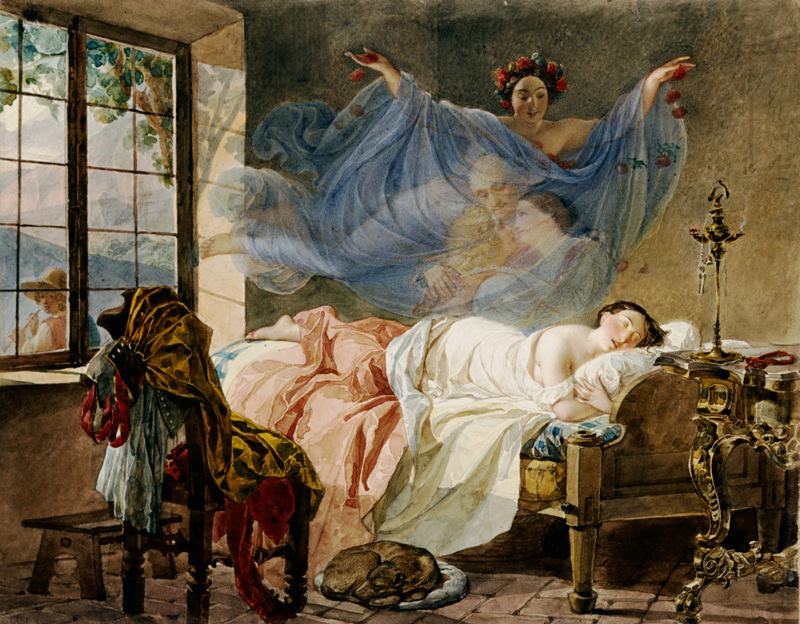
Painting: Briullov, Karl - A Dream of a Girl Before a Sunrise c1830-1833 watercolor.
Blue Box of Science:
Switch off your dreaming brain to reduce stress
Brain regions work together to complete different jobs. Regions of the brain that work together are known as brain networks.
Only one brain network is active at any time and they can switch back and forth with the help of the salience network (SN). The SN inhibits one network while switching on another. It decides what is important.
During rest your brain is in the default mode network (DMN). The DMN is also known as the imagination network. Its role involves self reflection, memories, daydreaming, mind wandering, inner monologue, divergent thinking, and theory of mind (assign mental states to others and ourselves).
An overactive DMN is associated with depression and anxiety. It can cause excessive rumination along with intrusive and critical thoughts.
To calm down the DMN you can switch your brain into another brain network, such as the central executive network (CEN). The CEN is the brain’s planner, problem solver, and fixer. It is involved with working memory, focused attention, and emotional control.
When your brain is running on CEN it cannot run DMN at the same time.
To switch you just need to turn on the logical part of your brain that likes to solve puzzles and use reason.
- Play tetris or other similar 3D mental rotation games
- Play problem solving games
- Do puzzles
- Look up interesting scientific facts
- Try to solve logic puzzles
- Mindfulness and meditation
Both physical or mental challenges turn on your CEN
When your CEN and DMN work together they tune up your creativity!
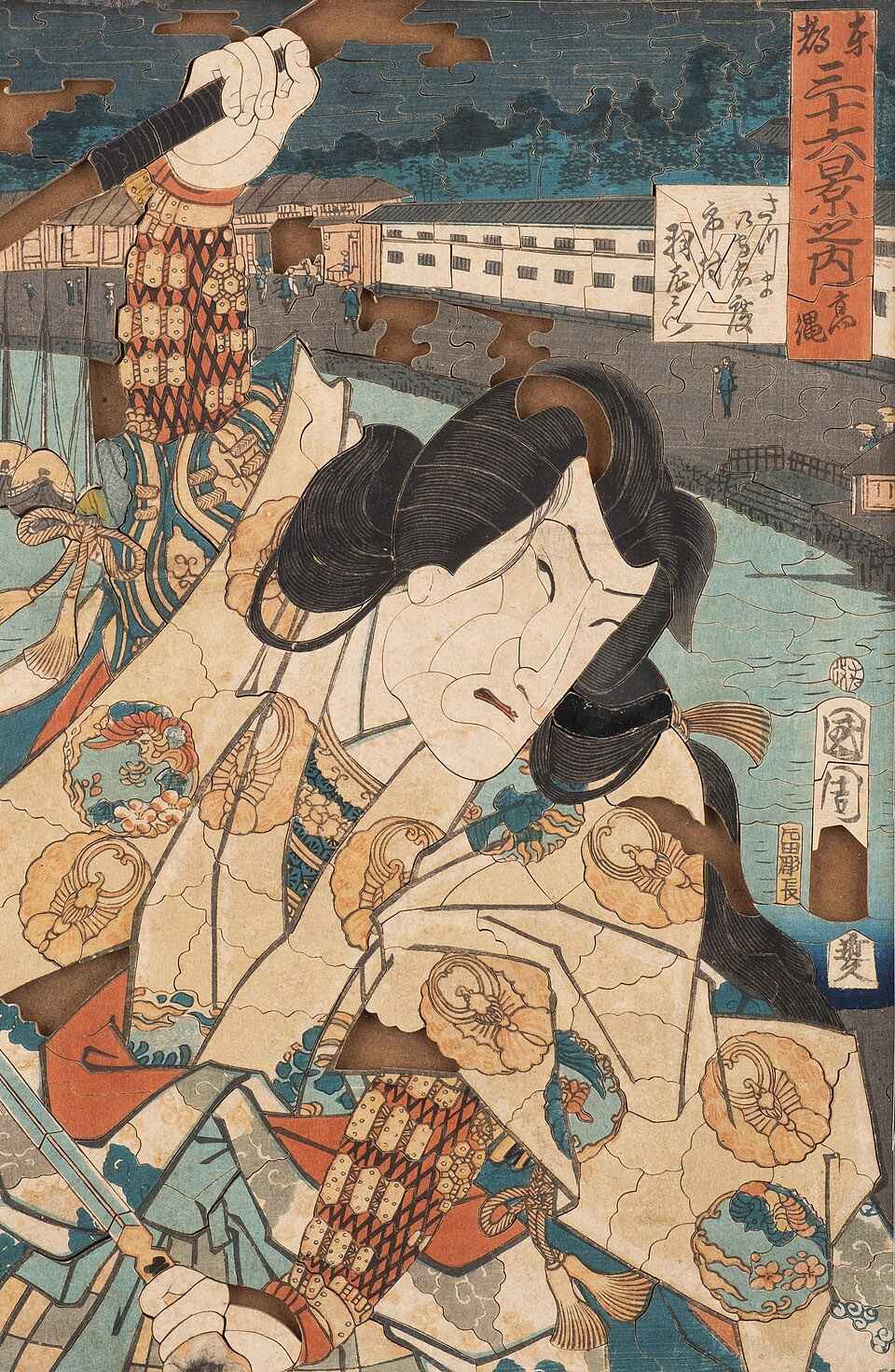
Kunichika Toyohara artist (before 1900's). Louis Vuitton jigsaw puzzle from 1920-30's woodcut on paper on wood.
Science Bite: How cortisol influences stress
People under stress release more cortisol. It is part of the bodies response to danger. Cortisol enhances glucose sugar) release which fuels the body; adding extra energy to help you react to the stressor.
Cortisol can be helpful since it releases glucose reserves to increase energy, helps to modulate inflammation and aids in forming memories. However, chronically high cortisol levels disrupt biofeedback loops causing anxiety, depression, weight gain, memory problems and more (Hannibal and Bishop 2014).
By Susan Fluegel PHD Nutritional Biochemistry
* Names and some other small details have been changed to protect people's privacy.
This information is for informational purposes only and does not constitute medical advice, diagnosis, or treatment.
References:
Akimbekov NS, Razzaque MS. Laughter therapy: A humor-induced hormonal intervention to reduce stress and anxiety. Curr Res Physiol. 2021;4:135-138. doi: 10.1016/j.crphys.2021.04.002. Full article.
Beckenstrom A, Bonsall M, Markham A et al. A digital imagery-competing task intervention for stopping intrusive memories in trauma-exposed health-care staff during the COVID-19 pandemic in the UK: a Bayesian adaptive randomised clinical trial The Lancet Psychiatry, 13, 233-247 Full article.
Butler O, Herr K, Willmund G, Gallinat J, Kühn S, Zimmermann P. Trauma, treatment and Tetris: video gaming increases hippocampal volume in male patients with combat-related posttraumatic stress disorder. J Psychiatry Neurosci. 2020 Jul 1;45(4):279-287. doi: 10.1503/jpn.190027. Full article.
Filetti CR, Tsakonas NC, Donzella B, Thomas KM, Gunnar MR. Share-the-load vs bring-your-own-judge: The effects of friends on social evaluative stress in early adolescence. Psychoneuroendocrinology. 2025 Feb;172:107254. doi: 10.1016/j.psyneuen.2024.107254. Epub 2024 Dec 5. Erratum in: Psychoneuroendocrinology. 2025 Mar 26;176:107446. doi: 10.1016/j.psyneuen.2025.107446. Full article.
Finn S, Fancourt D. https://pubmed.ncbi.nlm.nih.gov/29779734/ Prog Brain Res. 2018;237:173-200. doi: 10.1016/bs.pbr.2018.03.007. Abstract.
Koay WI, Dillon D. Community Gardening: Stress, Well-Being, and Resilience Potentials. Int J Environ Res Public Health. 2020 Sep 16;17(18):6740. doi: 10.3390/ijerph17186740. Full article.
Hannibal KE, Bishop MD. Chronic stress, cortisol dysfunction, and pain: a psychoneuroendocrine rationale for stress management in pain rehabilitation. Phys Ther. 2014 Dec;94(12):1816-25. doi: 10.2522/ptj.20130597. Full article.
Mariano IM, Amaral AL, Ribeiro PAB, Puga GM. A single session of exercise reduces blood pressure reactivity to stress: a systematic review and meta-analysis. Sci Rep. 2022 Jul 12;12(1):11837. doi: 10.1038/s41598-022-15786-3. Full article.
Meints K, Brelsford VL, Dimolareva M, Maréchal L, Pennington K, Rowan E, Gee NR. Can dogs reduce stress levels in school children? effects of dog-assisted interventions on salivary cortisol in children with and without special educational needs using randomized controlled trials. PLoS One. 2022 Jun 15;17(6):e0269333. doi: 10.1371/journal.pone.0269333. Full article.
Pankey T, Kelly PJ, Ramaswamy M. Stress Reduction Through a Brief Writing Intervention With Women in Jail. J Correct Health Care. 2016 Jul;22(3):240-6. doi: 10.1177/1078345816654230. Abstract.
Song Y, Mewes R, Skoluda N, Nater UM. How is music listening purpose related to stress recovery? - two preliminary studies in men and women. Front Psychol. 2023 Oct 10;14:1108402. doi: 10.3389/fpsyg.2023.1108402. Full article.
Sugano A, Nomura T. Influence of water exercise and land stretching on salivary cortisol concentrations and anxiety in chronic low back pain patients. J Physiol Anthropol Appl Human Sci. 2000 Jul;19(4):175-80. doi: 10.2114/jpa.19.175. Full article.