Service Dogs
Dogs can be our best friends and help us fight physical and mental illnesses
*Matteo J. (42 year old man). "My dog has saved my life. I tried therapy, a good diet, exercise, coping strategies, and even medication. But I needed something more to function. My dog noses me out of bed each morning, gets me out of negative head spaces, prompts me to exercise, gently herds me to bed at night, and generally gives me a rhythm to my day.
He is trained to help with blocking tasks, deep pressure therapy, alert to my anxiety and PTSD, and to gently keep people from crowding me. He can even escort me to my car or hotel room when my brain fog acts up. Besides that, he is a wonderful friend and exercise partner. He is never too tired to go for a run!"
How can service dogs help people?
Service dogs and other service animals can provide both physical and emotional support to people. Although many pets can provide emotional support, a qualified service animal must meet American with Disabilities (ADA) requirements.
The ADA requirements defines qualified service animals as:
Any breed of dog trained to perform a task directly related to a person's disability.
Mini-horses can also be qualified service animals if they are between 70-100 pounds, 24-34 inches high, housebroken, under the owner's control, able to enter and fit into the facility, and do not compromise any safety regulations.
The book of dogs; an intimate study of mankind's best friend (1919).
_84_11zon.jpg)
A canine courier of the Great War (WWI). Quote from The book of dogs; an intimate study of mankind's best friend: "This dog as a dispatch-bearer is three and a third times as efficient as a man, for in three minutes it will deliver to local headquarters the message being written by the officer, whereas a human courier would require ten minutes to make the trip."
 2_78_11zon.jpg)
Service animals provide help that is directly related to the person's disability:
★ Alert to seizures, abnormal blood glucose or the presence of allergens
★ Pull or guide a wheelchair
★ Prevent or interrupt disruptive or harmful behavior in people with mental health issues
★ Guide people who are sight impaired
★ Alert people who are hearing impaired
★ Retrieve or carry medications, phones or other items
★Remind people to take medications
★ Assist with prosthetic devices
★ Open doors and press buttons
★ Help with household task such as loading and unloading a washer and dryer
★ Provide physical support or stability to people who have mobility issues
Service Dogs for Mental Health:
Some dogs are trained to alleviate mental health issues.
PTSD service dogs can be trained to:
★ Interact with their person when the person is anxious or upset by moving close, leaning on the person or placing a friendly paw on them
★ Guide their handler away from stressful situations
★ Interrupt repetitive or injurious behavior
★ Stand in front of or behind their veteran to fend off crowds or approaching people
★ Wake a person from a nightmare by licking their face
★"Sweep" a room for other people before a handler enters
★ Perform security enhancement tasks
★ Alert to panic attacks
★ Provide environmental assessments (for handlers with paranoia or hallucinations)
From The book of dogs; an intimate study of mankind's best friend.
 3_79_11zon.jpg)
Trained emotional therapy dogs:
★ Basically well behaved and loving pets
★ Provide unconditional love and support
★ The act of caring for a dog 'forces' socialization and leaving the house
★ People often interact with people walking dogs
★ The dog provides a convenient and a safe ice breaker with others
Service dogs help people with PTSD
Kyle S. (53 year old military veteran): "For anyone who feels their life is not worth living; I want you to know you're worth it. I felt like I was just existing in life, not really living, just surviving. Some of my coping habits I had to use just to exist were things I was embarrassed about. I was in a dark space with no way out.
And suddenly my life changed; I was paired with a wonderful golden girl, Lei, my PTSD service dog. My world has changed due to her healing and love. She has given me my confidence back. She is a warrior to fight for me when I can't.
For all those struggling with your mental health; don't give up. - reach out and get help. People care about you; you are worthy to be loved! No matter what you think have done, how you feel, you deserve to heal and forgive yourself."
People with PTSD have intense, disturbing feelings, thoughts, and sometimes actions that are related to a traumatic experience long after the traumatic event has ended. You can have post traumatic stress disorder (PTSD) even if you have never been in the military.
Organizations that donate service dogs to qualified veterans.
Check out the research on the effectiveness of PTSD service dogs.
The evidence that dogs can help with physical limitations is overwhelming but there are still questions about how service animals impact mental health disorders. Veteran's Affairs funds dogs for physical disabilities, they are actually considered medical equipment, but not dogs for mental health disorders.
Additional research is needed before the VA funds veterans' dogs for PTDS. However, there are many organizations that may be able to provide a dog to those who need one.
VA may provide some expenses for service dogs. The VA may provide veterinary care, needed medications, and necessary equipment for trained service dogs. See What is the Service Dog Veterinary Health Insurance Benefit?
Service Dogs Reduce PTDS Symptoms in Veterans
The Pairing Assistance-Dogs with Soldiers (PAWS) recently reported positive benefits from PTSD service dogs. This yearlong study, funded by the Kaiser Permanente Center for Health Research and led by Carla Green, PhD, included 75 veterans.
Leighton et al. 2022 found that a partnership with a psychiatric assistance dog had a clinically meaningful, significant, and large effect on PTSD severity scores for military veterans. People spoke of "a greater sense of safety and calm, improved peace of mind, augmented sense of self-worth, and increased emotional reserves".
Military members and veterans with PTSD (156 people, mostly men), who received a service dog had lower PTSD symptom severity, lower anxiety, and lower depression after 3 months (Leighton et al. 2024.)
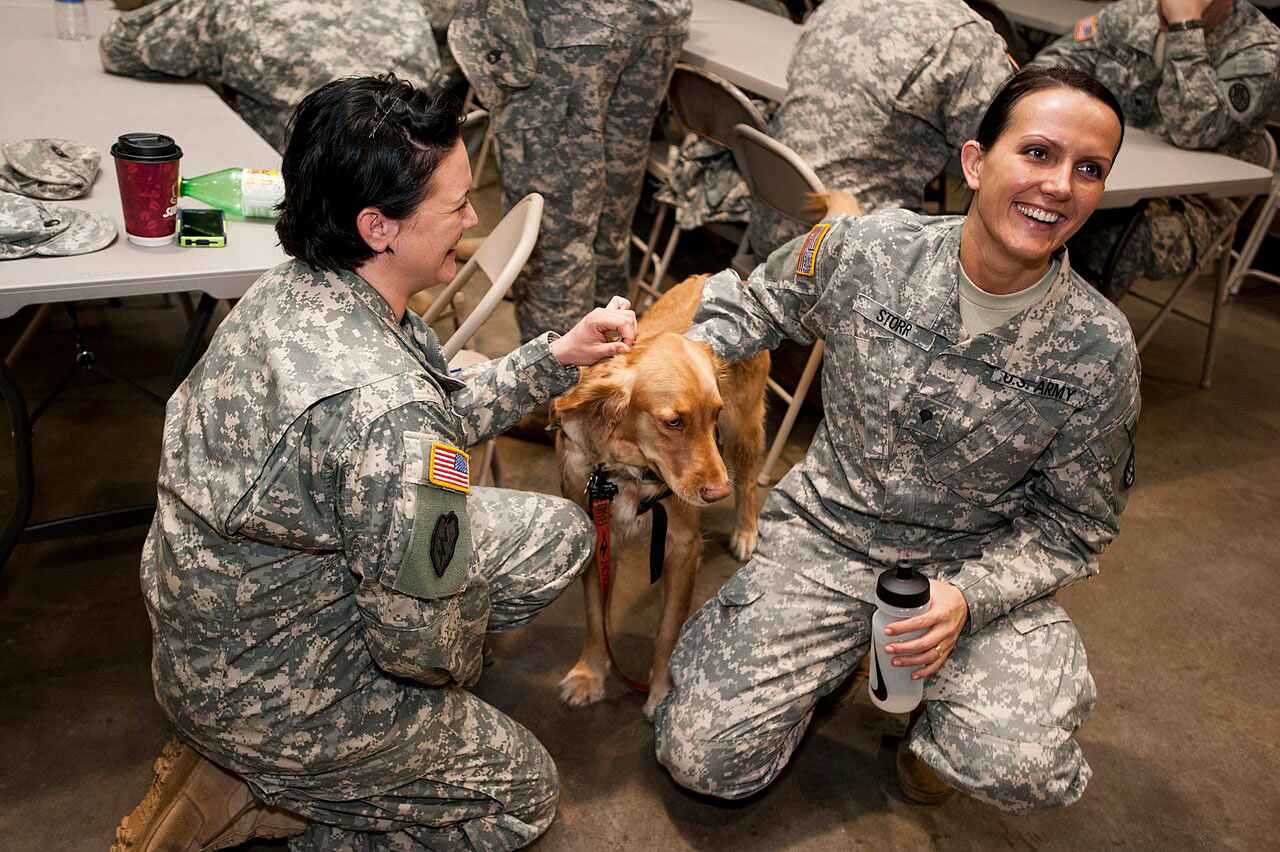
Sgt. 1st Class Meredith Kiser, left, and Spc. Natalia Storr, from North Carolina National Guard's Headquarters and Headquarters Company, 130th Maneuver Enhancement Brigade, pet Rosco, a PTSD companion animal. Photo taken by Staff Sgt. Mary Junell.
Service dogs:
★ significantly reduced veterans' symptoms of both post-traumatic stress (PTSD) and military sexual trauma (MST)
★ significantly reduced symptoms of depression
In addition, when compared to veterans without dogs, veterans who were given service dogs reported:
★ less severe symptoms of PTSD and MST (a subset of PTSD)
★ less substance abuse
★ less anger, social isolation, and work impairment
★ greater resilience and companionship
★ lower symptoms of depression
★ better interpersonal relationships
★ fewer psychiatric symptoms
★ improvement in sleep quality and greater peace of mind
★ greater happiness
Dogs acted as a social bridge to positively influence existing relationships and facilitate the development of new relationships.
No service dog? Try nature therapy to calm your PTSD.
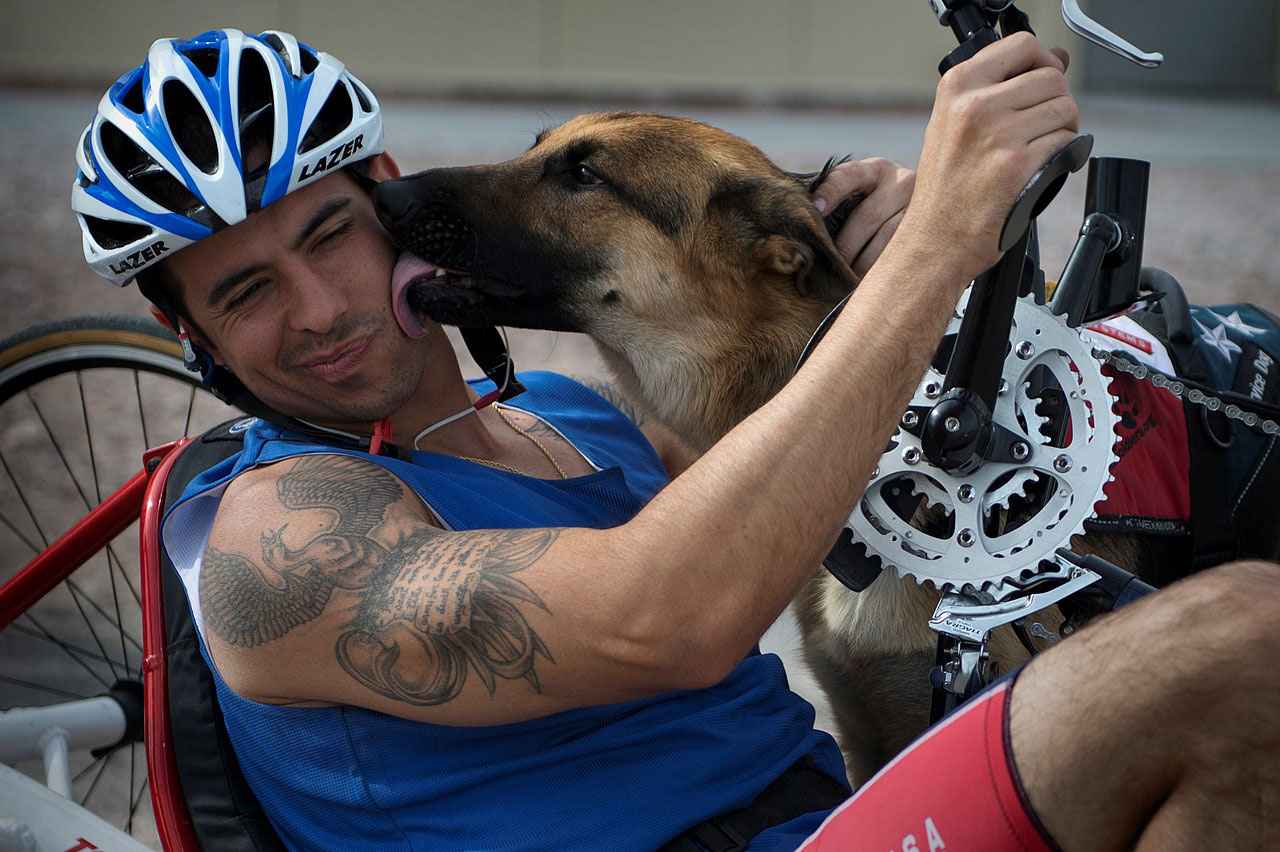
August O'Neill is kissed by Kai, his service dog, on April 9, 2014, during the cycling portion of the Air Force Trials at Nellis Air Force Base, Nevada. Photo by Senior Airman Jette Carr.
Current studies on benefits of PTDS service dogs and emotional therapy dogs:
Purdue University assistant professor Maggie O'Haire, PhD, looked at whether service dogs reduce post-traumatic stress syndrome (PTSD), traumatic brain injury (TBI) and/or military sexual trauma (MST) in veterans. In addition, the study explored the effect of a dog on the veterans partners or spouses.
O'Haire received a grant from the Human Animal Bond Research Initiative Foundation to measure the effect of service dogs on veterans with PTSD. She worked with K9 For Warriors, a non-profit organization that trains rescue/shelter dogs and pairs them with combat veterans suffering from PTSD, TBI and/or MST. The dogs are specifically trained to foster a feeling of safety, confidence and independence for their veteran.
The Purdue study recruited 82 post-9/11 veterans (79% men). This study assessed if an animal trained to help a veteran with PTSD influences aspect of PTSD including medical symptoms, social anxiety, and relationships with other people.
Some interesting results of this study:
★ veterans spent an average of 82% of their time with their dog
★ all veterans had less anxiety and depression after getting a service dog
★ just caring for a dog improved people's mental health
★ people had a closer bond and less severe PTSD if the dog was less excitable (all the service dogs were selected for fairly calm temperament so the ideal PTSD service dog was really chill!)
★ people who had worse mental health at follow-up were more likely to use the dog to initiate a social greeting "make a friend"
★ veterans with better mental health at the follow up used less dominance-based training methods, perceived the emotional/logistical costs of service dog partnership as lower, and had a closer relationship with their service dog
★ the most frequent task people asked of their dog was to calm their anxiety
In addition to the Purdue study, VA conducted an 18 month study looking at both PTSD service dogs and companion dogs. This study recruited 181 veterans (age 22-79 years). Army veteran canine trainer Derrick Tillman is the programs manager and the VA's national dog trainer.
In this rigorous study, veterans were paired with either a trained service dog or a trained emotional support dog. Veterans' progress with the two types of dogs was compared to determine if improvement is due to having a canine companion or due to the dog's ability to perform specific trained tasks. The service dogs were trained in several commands chosen specifically for veterans with PTSD to help them feel safe.
Both groups benefited from having a dog companion. Veterans with a trained service dog group had a greater reduction in PTSD symptoms and better antidepressant adherence compared to those with an emotional support dog.
Service dog commands include:
★ Lights: turn on lights.
★ Block and Behind: stand in front or behind the veteran to create a secure place.
★ Sweep: enter the room before the veteran and bark if someone is present.
★ Bring: fetch.
Veterans in the study also receive therapy. All veterans had the option to keep their dog after the study.
Do you need a service dog?
A service dog can be your partner and help you regain peace and independence. You deserve to get the help you need! Service dogs can be expensive but many programs have alternate funding available if you qualify.
Check out these organizations that donate fully trained service dogs to veterans.
Photograph by William Henry A COLLIE OF ROYAL ANCESTRY BECAME THE MASCOT OF AMERICAN SOLDIERS Quote from The book of dogs: "Before he "joined the army," this dog of blooded lineage bore the name of Bum." Now he answers to the more appropriate title of "Bullets."
 4_80_11zon.jpg)
By Susan Fluegel PHD Nutritional Biochemistry
*Names and some minor identifying details in all stories in this website are changed to protect people's privacy.
This information in this website is for informational purposes only and does not constitute medical advice, diagnosis, or treatment.
References:
Jensen CL, Rodriguez KE, MacLean EL, Abdul Wahab AH, Sabbaghi A, O'Haire ME. Characterizing veteran and PTSD service dog teams: Exploring potential mechanisms of symptom change and canine predictors of efficacy. PLoS One. 2022 Jul 27;17(7):e0269186. doi: 10.1371/journal.pone.0269186. Full article.
Leighton SC, Nieforth LO, O'Haire ME. Assistance dogs for military veterans with PTSD: A systematic review, meta-analysis, and meta-synthesis. PLoS One. 2022 Sep 21;17(9):e0274960. doi: 10.1371/journal.pone.0274960. Full article.
Leighton SC, Rodriguez KE, Jensen CL, MacLean EL, Davis LW, Ashbeck EL, Bedrick EJ, O'Haire ME. Service Dogs for Veterans and Military Members With Posttraumatic Stress Disorder: A Nonrandomized Controlled Trial. JAMA Netw Open. 2024 Jun 3;7(6):e2414686. doi: 10.1001/jamanetworkopen.2024.14686. Full article.
Richerson JT, Wagner TH, Abrams T, Skelton K, Biswas K, Illarmo S, McSherry F, Fallon MT, Frakt A, Pizer S, Magruder KM, Groer S, Dorn PA, Huang GD, Stock EM. Therapeutic and Economic Benefits of Service Dogs Versus Emotional Support Dogs for Veterans With PTSD. Psychiatr Serv. 2023 Aug 1;74(8):790-800. doi: 10.1176/appi.ps.20220138. Full VA report here.