How Stress Activates Long COVID
Are you stressed about Long COVID (LC)? It gets worse.
Being stressed before you catch COVID-19 increases your chance of developing Long COVID.
A large study of 54,960 people (96.6% were women with a mean age of 57.5 years), found that being in psychological distress can increase the risk of Long COVID. Psychological distress includes worry, depression, anxiety, loneliness, and perceived stress.
Being stressed out before you catch COVID-19 gives you a 32%-46% increased risk of developing long COVID (Wang et al. 2022). Those who had 2 or more types of psychological distress before catching COVID-19 were almost 50% more likely to get Long COVID. For those who developed LC, increased worry and psychological distress also increased the risk of daily life impairment that are related to post COVID-19 conditions.
To make this even worse, one study of 1,087 women and men (from 18 to over 75 years old) found that those who had increased stress, worry about COVID-19, distress, loneliness, anxiety and depression at the start of the pandemic were at greater risk of getting Covid-19 and of having worse symptoms (Ayling et al. 2022).
Why does stress increase your chance of illness?
Stress can activate mast cells
Mast cells are immune cells found throughout the body. While mast cells can be protective they also can cause allergic reactions such as asthma, food allergies, hives and other environmental allergies.
As mask cells activate they begin to react more strongly to harmless substances. When exposed to something they believe to be a threat they release histamine which causes swelling, itchiness, shortness of breath, wheezing or coughing, and/or hot flushed skin. A more severe reaction can lead to a life threatening allergic reaction called anaphylaxis.
Mast cells play a crucial role in the peripheral inflammation (inflammation that occurs outside the central nervous system) as well as in neuroinflammation due to brain injuries, stress, depression, and PTSD. Therefore, mast cells activation in brain injury, stress, and PTSD may contribute to neuroinflammatory and neurodegenerative diseases (Kempuraj et al. 2017).
Stress increases inflammation
Chronic stress can causes inflammatory changes in the brain and the peripheral immune system. These changes cause chronic inflammation and increase the risk of physical and psychiatric disorders (Lui et al. 2017, Kim et al. 2022). Constant whole body inflammation activates the immune system and accelerates development of stress related disorders.
Break the stress cycle
So there is a vicious cycle, worrying about catching COVID-19 makes you more likely to catch COVID-19 and more likely to develop Long COVID. Whether you already have Long COVID or not, you need to break the cycle.
Here are some fun ways to break the stress cycle:
Combat stress with nature therapy. Hanging out or hiking in natural areas will help deactivate your stress cycle.
Make art to reduce stress. Looking at and making art will help you heal.
Laughing reduces stress! Watch some funny videos or read humorous books!
Listening to or making music reduces stress and improves health. So start banging on those drums.
Bonus content: Having a chronic illness increases your chance of a COVID-19 infection
People living with a chronic illness have an increased chance of catching COVID-19, having COVID-19 complications, and dying from COVID-19.
Compared to healthy people, people with a chronic illness are more likely to be stressed out about COVID-19, to have someone close to them die of COVID-19, to suffer loneliness, to experience family problems and to have financial problems. They are also more likely to have depression, anxiety, and post-traumatic stress disorder (discussion Bhatt et al. 2023).
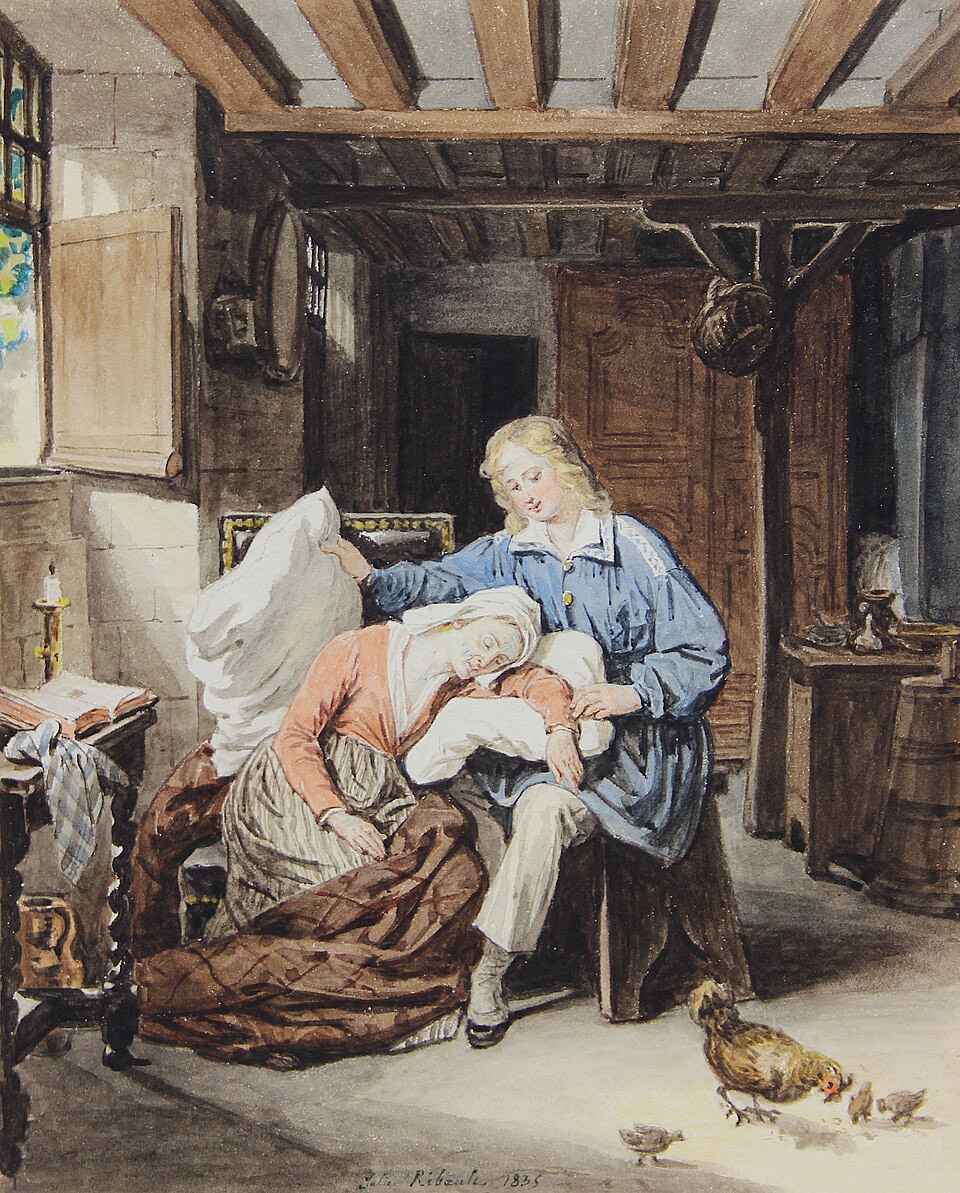
Julie Ribault - The Sick Mother, 1835 watercolor.
Blue Box of Science: Chronic Stress Causes Disease
When something stressful happens our bodies prepare to fight, flee, freeze (or 'friend/fawn').
Stress activates the sympathetic nervous system (SNS) and the hypothalamic-pituitary-adrenal (HPA) axis. The SNS is a subsystem of the nervous system that help your body respond in stressful situations (fight, freeze, flee or friend). The HPA axis is a neuroendocrine system that facilitates communicates between the hypothalamus, the pituitary gland, and the adrenal glands. In response to nervous system stimulation, the HPA axis releases hormones via the endocrine system.
Stress unleashes a cascade of multiple neurochemical, neurotransmitters and hormones. When stress is under control (or if you have isolated incidences of stress) your body can dissipate the excess stress chemicals. Exercise works great to help rid your body of excess stress chemicals! When stress is out of control you get chronic stress. Fight back against stress with five minute stress busters.
Chronic stress causes an abnormal feedback loop that screws up the immune system, the central nervous system, and the endocrine system
One current theory is that under constant stress, an abnormal feedback loop occurs involving the central nervous system (CNS), immune system (IS), and endocrine system (ES) (Zefferino et al. 2021).
Under normal physiological conditions, the neurotransmitter and hormone norepinephrine (NE) activates the HPA axis and controls cortisol production. In turn cortisol down regulates interleukin (IL)-1β production. IL-1β is a pro-inflammatory cytokine so you don't want it to get out of control. It is produced by the body in response to infection.
However, during chronic stress the high levels of glucocorticoids (GCs) cause the HPA axis to develop GC resistance. GC are steroid hormones that are produced by the adrenal glands; they help maintain stress-related homeostasis. Glucocorticoid resistance allows proinflammatory signaling pathways, such as those with interleukin (IL)-1β, to stop responding to normal feedback inhibition.
Due to this breakdown in communication, IL-1β amounts increase unchecked. High concentrations of IL-1β influences norepinephrine (NE) and causes it to attempt to use melatonin and cortisol as a countermeasure to high IL-1β. Sadly, cortisol resistance actually increases IL-1β more. To read more about this abnormal feedback loop see Zefferino et al. 2021.
Your brain is affected by chronic stress as well! Under stress the brain accumulates pro-inflammatory cytokines, has increased glia activation and attracts white blood cells [peripherally-derived monocytes (PBMC) and macrophages] (Johnson et al. 2005, Lui et al. 2017). Glia activation contributes to inflammation and the chronic pain cycle.
By Susan Fluegel PHD Nutritional Biochemistry
*Names and some minor identifying details in all stories in this website are changed to protect people's privacy.
This information in this website is for informational purposes only and does not constitute medical advice, diagnosis, or treatment.
References:
Ayling K, Jia R, Coupland C, Chalder T, Massey A, Broadbent E, Vedhara K. Psychological Predictors of Self-reported COVID-19 Outcomes: Results From a Prospective Cohort Study. Ann Behav Med. 2022 May 18;56(5):484-497. doi: 10.1093/abm/kaab106. Full article.
Bhatt KJ, Schulder T, Rudenstine S, McNeal K, Ettman CK, Galea S. Understanding the Mental Health Impact of the COVID-19 Pandemic Among Individuals With Chronic Illness. Psychol Rep. 2023 Mar 18:332941231164338. doi: 10.1177/00332941231164338. Full article.
Catalí M, Mercadú-Besora N, Kolde R, Trinh NTH, Roel E, Burn E, Rathod-Mistry T, Kostka K, Man WY, Delmestri A, Nordeng HME, Uusküla A, Duarte-Salles T, Prieto-Alhambra D, Jödicke AM. The effectiveness of COVID-19 vaccines to prevent long COVID symptoms: staggered cohort study of data from the UK, Spain, and Estonia. Lancet Respir Med. 2024 Mar;12(3):225-236. doi: 10.1016/S2213-2600(23)00414-9. Full article.
Cohen S, Miller GE, Rabin BS. Psychological stress and antibody response to immunization: a critical review of the human literature. Psychosom Med. 2001 Jan-Feb;63(1):7-18. doi: 10.1097/00006842-200101000-00002. Abstract.
Greenhalgh T, Sivan M, Perlowski A, Nikolich J. Long COVID: a clinical update. The Lancet, 2024; doi: 10.1016/S0140-6736(24)01136-X. Full article.
Johnson JD, Campisi J, Sharkey CM, Kennedy SL, Nickerson M, Greenwood BN, Fleshner M. Catecholamines mediate stress-induced increases in peripheral and central inflammatory cytokines. Neuroscience. 2005;135(4):1295-307. doi: 10.1016/j.neuroscience.2005.06.090. Full article.
Kempuraj D, Selvakumar GP, Thangavel R, Ahmed ME, Zaheer S, Raikwar SP, Iyer SS, Bhagavan SM, Beladakere-Ramaswamy S, Zaheer A. Mast Cell Activation in Brain Injury, Stress, and Post-traumatic Stress Disorder and Alzheimer's Disease Pathogenesis. Front Neurosci. 2017 Dec 12;11:703. doi: 10.3389/fnins.2017.00703. Full article.
Kim I-B, Lee J-H, Park S-C. The Relationship between Stress, Inflammation, and Depression. Biomedicines. 2022; 10(8):1929. https://doi.org/10.3390/biomedicines10081929 Full article.
Liu YZ, Wang YX, Jiang CL. Inflammation: The Common Pathway of Stress-Related Diseases. Front Hum Neurosci. 2017 Jun 20;11:316. doi: 10.3389/fnhum.2017.00316. Full article.
Thompson EJ, Williams DM, Walker AJ, Mitchell RE, Niedzwiedz CL, Yang TC, Huggins CF, Kwong ASF, Silverwood RJ, Di Gessa G, Bowyer RCE, Northstone K, Hou B, Green MJ, Dodgeon B, Doores KJ, Duncan EL, Williams FMK; OpenSAFELY Collaborative, Steptoe A, Porteous DJ, McEachan RRC, Tomlinson L, Goldacre B, Patalay P, Ploubidis GB, Katikireddi SV, Tilling K, Rentsch CT, Timpson NJ, Chaturvedi N, Steves CJ. Long COVID burden and risk factors in 10 UK longitudinal studies and electronic health records. Nat Commun. 2022 Jun 28;13(1):3528. doi: 10.1038/s41467-022-30836-0. Full article.
Wang S, Quan L, Chavarro JE, Slopen N, Kubzansky LD, Koenen KC, Kang JH, Weisskopf MG, Branch-Elliman W, Roberts AL. Associations of Depression, Anxiety, Worry, Perceived Stress, and Loneliness Prior to Infection With Risk of Post-COVID-19 Conditions. JAMA Psychiatry. 2022 Nov 1;79(11):1081-1091. doi: 10.1001/jamapsychiatry.2022.2640. Erratum in: JAMA Psychiatry. 2022 Sep 28;: Full article.
Zefferino R, Di Gioia S, Conese M. Molecular links between endocrine, nervous and immune system during chronic stress. Brain Behav. 2021 Feb;11(2):e01960. doi: 10.1002/brb3.1960. Full article.