Seniors and Ill People Need More Protein
People who are older, chronically inflamed, ill, and/or inactive need to eat more protein
Can you remember floppy disks?
Did you wear low rider pants the first time around?
If so, you need more protein.
Other factors besides age that cause anabolic resistance are chronic inflammation, physical inactivity, insulin resistance, nutrient deficiencies, metabolic stress, and inadequate protein intake. Chronic inflammation can cause many diseases that are blamed on getting older.
As you age, your body processes protein less efficiently due to anabolic resistance. Anabolic resistance is when the body has a difficult time responding to muscle growing stimuli like exercise or protein. As a result, there is reduced muscle growth. Older people have as much as a 40% reduction in muscle protein synthesis efficiency compared to younger people.
Reduction in muscle mass and strength can cause age-related muscle attenuation, called sarcopenia. Sarcopenia is correlated with frailty. Frailty is when the body is weak and unable to handle or recover from illness or stress. Both sarcopenia and frailty can cause muscle weakness as well as impaired ability to function.
Not eating enough protein can reduce your strength. When looking at senior women and men (5362 people, age 50-70 years old); those with low handgrip strength had the lowest intake of all the protein groups (protein groups were dairy products; meat and fish; and eggs and legumes) (Eglseer et al. 2022). Adding supplemental protein increases muscle mass and function in adults over 65 years old (Kwon et al. 2023). If you are a vegetarian or a vegan check out plant based proteins.
The Pensioners Story by Thomas Davidson 1883 oil on canvas.

- Protein needed for optimal health
- Seniors lose muscle mass when eating the current DRI recommendation for protein
- Need 20-35 grams protein per meal
- Want to build lean tissue? Eat 25-35 grams of protein 2-3 times a day
- Want strong bones? Eat more protein and exercise
- Protein intake is associated with less perceived cognitive decline
- Strength (resistance) exercise plus protein increases muscle synthesis
- Essential amino acids prompt lean tissue gains
- Science Bite: Leucine initiates muscle protein synthesis (MPS) after eating.

How much protein is needed for optimal health?
Healthy older adults need between 1.1 g and 1.3 g protein/kg/body weight (bw) to improve muscle protein synthesis (MPS) and maintain lean body mass. This is 0.5 g protein per pound of body weight (Nowson and O'Connell 2015, Harris et al. 2025).
Seniors who have chronic disease(s), malnutrition, acute illness, risks for frailty, and/or other inflammatory conditions, need to increase their dietary protein to between 1.2 and 1.5 g protein/kg/bw or 0.5-0.7 g protein/lb/bw.
People with severe illnesses or risk factors may need up to 2.0 g protein/kg/bw or 0.9 g protein/lb/bw, to support immune function. In this case, a 150 pound chronically ill senior would need 136 grams protein a day.
(According to recent research: see discussion Harris et al. 2025)

Seniors actually lose muscle mass when eating the current DRI recommendation for protein per day
In one study, adults (55–77 years) ate the current recommendation for protein, 0.8 g protein/kg/bw. People lost skeletal muscle mass, as measured by a decreased mid-thigh muscle area, and they had reduced urinary nitrogen excretion as the study progressed. Nitrogen is mostly found in protein; when people excrete less nitrogen it means their bodies are holding on to proteins). The decrease over time in urinary nitrogen excretion suggests that people did not achieve a metabolic steady state at 0.8 g protein and continued to lose muscle mass (Campbell et al. 2010).
This means older people need to eat more protein just to maintain their lean muscle.
Eat at least 20-35 grams protein for each meal
Recent research has suggested that people aim for a per meal protein requirement instead of a daily protein requirement (discussion Weiler et al. 2023).
Muscle protein breakdown and muscle protein synthesis (building) rates are highly responsive to both food intake, particularly protein intake, and to physical activity. How much protein per meal you need to eat to optimize postprandial MPS depends on age, the essential amino acid content of the protein (especially leucine which stimulates muscle protein synthesis), and whether or not you are doing strength training (resistance training).
People start losing skeletal muscle mass at around 50 years old. There is no difference in protein absorption between young and older women and men; but there is less muscle growth response to the protein intake. In other words, older people need to absorb more protein at a meal to jump start postprandial MPS. This failure of your muscles to respond to protein is called anabolic resistance (discussion Tian et al. 2016, Burd et al. 2019).
While muscle mass is lost at a rate of about 0.8% a year, strength loss occurs at a faster rate of 2-3% per year. This is due to a combination of aging, being less active, and diet. The best way to combat anabolic resistance is a combination of high quality protein meals and some form of strength training (discussion Nowson and O'Connell 2015, Burd et al. 2019). Exercise is also the fountain of youth for your mitochondria.
Too many people neglect protein as they get older. Jules Jacques Veyrassat 1828-1893 - Interior with an Old Woman Eating Soup 1953 oil on canvas.

Want to build lean tissue? Eat 25-35 grams of protein 2-3 times a day
You need to maintain lean muscle if you want to age successfully. The average young adult (22 years old) has almost 48% lean muscle mass compared to 25% lean muscle mass in the average 78 years old. Muscle weakness is correlated with frailty, osteoporosis, risk of falling and reduced life expectancy. Stronger muscles equal stronger bones and more resilience to injury and illness (discussion Nowson and O'Connell 2015).
Meeting optimal per meal protein intakes (in most cases 25-35 grams protein) results in maximal postprandial muscle protein synthesis (MPS) in adults of all ages. MPS is when the body builds the proteins for muscles after a meal.
Healthy older men (48 men, average age 66 years old) consumed either 0, 15, 30, or 45 grams of milk protein concentrate after resistance exercise (leg press, leg extension, lat pulldowns, and chest press). Thirty grams of milk concentrate protein is around 1/3 cup. Ingestion of greater than 30 g milk protein after exercise increased muscle (myofibrillar) protein synthesis rates in the men (Holwerda et al. 2019).
In a similar line, 60 healthy older women and men (mean age 61 years old) either received a milk based protein supplement (0.165 g/kg body mass) or a maltodextrin control with the same caloric count at breakfast and lunch. Basically a 150 lb person would be given an extra 11 gram protein for breakfast and lunch. Consuming the protein supplement for 24 wk increased lean tissue mass by 0.6 kg compared to the maltodextrin control (Norton et al. 2016).
You are never too old to improve your health or your mind. Age successfully by supporting brain growth and creativity. Many successful writers and artists started after retirement. Art can be very healing.
Frants Henningsen A man working near a farmhouse 1886 oil on panel.

Want strong bones? Eat more protein and exercise
People over 65 years old who had a higher protein intakes (over the current DRI recommendation of of 0.8 g/kg body weight/day) had 11% less hip fractures than those with lower protein intake. People who ate more protein also had higher bone density in neck and hips (Groenendijk et al. 2019). A similar study with women over 65 years also saw an 11% decrease in hip fractures in those eating the most protein (Wu et al 2015).
Physical activity also significantly decreases your risk of bone fractures. People who are active have a 29% lower risk of all types of fracture when compared with people who don't perform physical activity. People who had more physical activity had a 39% less risk of hip fractures and a 28% lower risk of wrist fracture (Qu et al. 2019). You can learn to motivate yourself to exercise.
Protein intake is associated with less perceived cognitive decline
Women (49,493) who had a higher total, animal, and plant protein compared with total carbohydrates had a lower risk of subjective cognitive decline (Yeh et al. 2022).
Subjective cognitive decline is a person's perception of cognitive decline without standard tests showing cognitive impairments. Subjective cognitive decline is often an early indictor of mild cognitive impairment and dementia.
Keep your brain sharp no matter your age with healthy food and exercise!
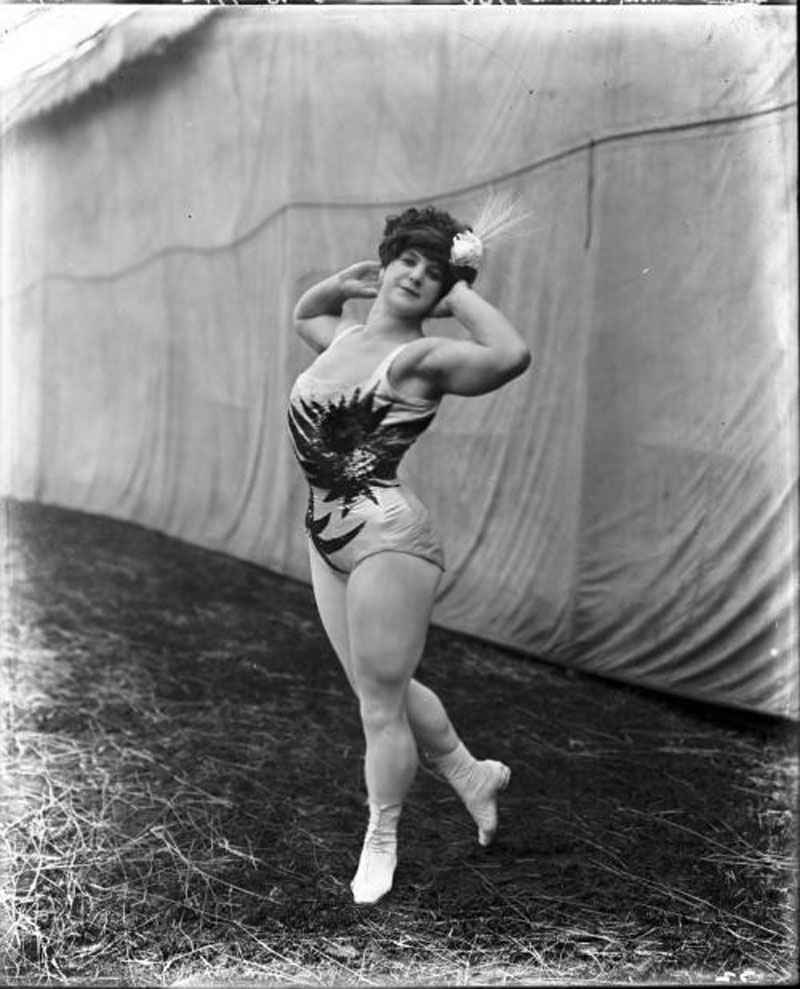
Famous strongwoman Katie Sandwina in 1912. She was billed as 'Sandwina, Europe's Queen of Strength, Beauty and Dexterity.'
Strength (resistance) exercise plus protein increases muscle synthesis
Healthy older women (57 people, age 50-70 years) were given a supplemental milk protein powder to consume at breakfast and lunch. The supplement amount was adjusted for their weight; it added around 8.5-16 grams protein per meal. Half of the women also did 45-60 minutes of supervised strength training exercises 3-times a week.
In comparison to the protein group, women in the protein plus exercise group had an increase in upper leg lean tissue mass; an increase in knee extensor (KE) torque; and an increase in extended gait speed (Francis et al. 2016).
Essential amino acids prompt lean tissue gains
Total consumption of essential amino acids (EAA), at least in older adults, may be what prompts stimulation of muscle protein synthesis after eating (Jonker et al. 2017).
Protein powders high in EAA, such as whey or casein, are very effective at stimulating whole body protein anabolism (growth of muscles and lean tissue) in healthy and in non-healthy people. Researchers wondered if using a even more pure mix of EAA with some added leucine would result in even greater muscle gains.
Nineteen older adults that were healthy (64 +/- 2 years) were age matched with 23 people that had severe chronic obstructive pulmonary disease (COPD) (65 +/- 2 years). In a double blind cross-over study, the researchers looked at whether a free EAA mixture with a high proportion (40%) of leucine (called the EAA mixture) stimulated whole body net protein gain more than a very similar mixture containing balanced free EAAs and non-EAAs such as present in whey protein (called the TAA mixture).
They reported that the net protein gain was 49% higher in COPD patients and 42% higher in healthy controls after consuming the EAA mixture as compared to the TAA mixture (Jonker et al. 2017).
Add exercise for better results
In independent, healthy older women and men (age 71 +/- 1 year) a 24-week aerobic exercise training program (3 times per week) increased walking speed and aerobic fitness. When the fitness program was combined with EAA supplementation, it increased both muscle strength and EAA-stimulated muscle protein synthesis. Both the increase in strength and protein synthesis occurred without any improvements in muscle mass. Exercise can also decrease your risk of metabolic disorders like T2D.
The EAA supplementation was given at 0.2g/kg body weight. The composition of the EAA mix was 40% L-leucine, 16.7% L-lysine, 11% L-valine, 10.7% L-isoleucine, 9.3% L-threonine, 6.7% L-phenylalanine, 3.3% L-methionine, 1.7% histidine, and 0.7% L-tryptophan (Markofski et al. 2019).
Science Bite: Leucine initiates muscle protein synthesis (MPS) after eating.
Leucine, an essential amino acid, activates the mammalian target rapamycin pathway (mTOR) pathway. The mTOR pathway helps maintain stable conditions in cells (cellular homeostasis) by controlling metabolism, immune responses, catabolism, autophagy, survival, proliferation, and migration.
Dysregulated mTOR signaling is linked with some diseases including aging, insulin resistance, osteoporosis, neurological disorders, and cancers (discussion Panwar et al. 2023).
By Susan Fluegel PHD Nutritional Biochemistry and Lori Wood MS Human Nutrition.
*Names and some minor identifying details in all stories in this website are changed to protect people's privacy
I'm not your doctor so this is not medical information. I'm just a person who would like to see you happy and healthy. If you have any questions or concerns about starting an exercise regiment, diet program, or supplements please consult a professional.
References:
Blomstrand E. A role for branched-chain amino acids in reducing central fatigue. J Nutr. 2006 Feb;136(2):544S-547S. doi: 10.1093/jn/136.2.544S. Full article.
Burd NA, McKenna CF, Salvador AF, Paulussen KJM, Moore DR. Dietary Protein Quantity, Quality, and Exercise Are Key to Healthy Living: A Muscle-Centric Perspective Across the Lifespan. Front Nutr. 2019 Jun 6;6:83. doi: 10.3389/fnut.2019.00083. Full article.
Campbell WW, Trappe TA, Wolfe RR, Evans WJ. The recommended dietary allowance for protein may not be adequate for older people to maintain skeletal muscle. J Gerontol A Biol Sci Med Sci. 2001 Jun;56(6):M373-80. doi: 10.1093/gerona/56.6.m373. Abstract.
Churchward-Venne TA, Pinckaers PJM, Smeets JSJ, Betz MW, Senden JM, Goessens JPB, Gijsen AP, Rollo I, Verdijk LB, van Loon LJC. Dose-response effects of dietary protein on muscle protein synthesis during recovery from endurance exercise in young men: a double-blind randomized trial. Am J Clin Nutr. 2020 Aug 1;112(2):303-317. doi: 10.1093/ajcn/nqaa073. Full article.
Coelho-Junior HJ, Marzetti E, Picca A, Cesari M, Uchida MC, Calvani R. Protein Intake and Frailty: A Matter of Quantity, Quality, and Timing. Nutrients. 2020 Sep 23;12(10):2915. doi: 10.3390/nu12102915. Full article.
Dimou A, Tsimihodimos V, Bairaktari E. The Critical Role of the Branched Chain Amino Acids (BCAAs) Catabolism-Regulating Enzymes, Branched-Chain Aminotransferase (BCAT) and Branched-Chain α-Keto Acid Dehydrogenase (BCKD), in Human Pathophysiology. Int J Mol Sci. 2022 Apr 5;23(7):4022. doi: 10.3390/ijms23074022. Full article.
Eglseer D, Traxler M, Bauer S. Association between the Intake of Different Protein Sources and Obesity Coexisting with Low Handgrip Strength in Persons near Retirement Age. Nutrients. 2022 Nov 5;14(21):4684. doi: 10.3390/nu14214684. Full article.
Elango R, Humayun MA, Ball RO, Pencharz PB. Evidence that protein requirements have been significantly underestimated. Curr Opin Clin Nutr Metab Care. 2010 Jan;13(1):52-7. doi: 10.1097/MCO.0b013e328332f9b7. Full pdf.
Francis P, Mc Cormack W, Toomey C, Norton C, Saunders J, Kerin E, Lyons M, Jakeman P. Twelve weeks' progressive resistance training combined with protein supplementation beyond habitual intakes increases upper leg lean tissue mass, muscle strength and extended gait speed in healthy older women. Biogerontology. 2017 Dec;18(6):881-891. doi: 10.1007/s10522-016-9671-7. Full article.
Groenendijk I, den Boeft L, van Loon LJC, de Groot LCPGM. High Versus low Dietary Protein Intake and Bone Health in Older Adults: a Systematic Review and Meta-Analysis. Comput Struct Biotechnol J. 2019 Jul 22;17:1101-1112. doi: 10.1016/j.csbj.2019.07.005. Full article.
Harris S, DePalma J, Barkoukis H. Protein and Aging: Practicalities and Practice. Nutrients. 2025 Jul 28;17(15):2461. doi: 10.3390/nu17152461. Full article.
Holwerda AM, Paulussen KJM, Overkamp M, Goessens JPB, Kramer IF, Wodzig WKWH, Verdijk LB, van Loon LJC. Dose-Dependent Increases in Whole-Body Net Protein Balance and Dietary Protein-Derived Amino Acid Incorporation into Myofibrillar Protein During Recovery from Resistance Exercise in Older Men. J Nutr. 2019 Feb 1;149(2):221-230. doi: 10.1093/jn/nxy263. Full article.
Janssen I. Evolution of sarcopenia research. Appl Physiol Nutr Metab. 2010 Oct;35(5):707-12. doi: 10.1139/H10-067. Abstract.
Jonker R, Deutz NE, Erbland ML, Anderson PJ, Engelen MP. Effectiveness of essential amino acid supplementation in stimulating whole body net protein anabolism is comparable between COPD patients and healthy older adults. Metabolism. 2017 Apr;69:120-129. doi: 10.1016/j.metabol.2016.12.010. Full
Kwon HE, Ko N, Yuk D, Choi SW, Koh SE. Improved Muscle Mass and Function With Protein Supplementation in Older Adults With Sarcopenia: A Meta-Analysis. Ann Rehabil Med. 2023 Oct;47(5):358-366. doi: 10.5535/arm.23076. Full article.
Mamerow MM, Mettler JA, English KL, Casperson SL, Arentson-Lantz E, Sheffield-Moore M, Layman DK, Paddon-Jones D. Dietary protein distribution positively influences 24-h muscle protein synthesis in healthy adults. J Nutr. 2014 Jun;144(6):876-80. doi: 10.3945/jn.113.185280. Full article.
Markofski MM, Jennings K, Timmerman KL, Dickinson JM, Fry CS, Borack MS, Reidy PT, Deer RR, Randolph A, Rasmussen BB, Volpi E. Effect of Aerobic Exercise Training and Essential Amino Acid Supplementation for 24 Weeks on Physical Function, Body Composition, and Muscle Metabolism in Healthy, Independent Older Adults: A Randomized Clinical Trial. J Gerontol A Biol Sci Med Sci. 2019 Sep 15;74(10):1598-1604. doi: 10.1093/gerona/gly109. Full article.
Morris R, Black KA, Stollar EJ. Uncovering protein function: from classification to complexes. Essays Biochem. 2022 Aug 10;66(3):255-285. doi: 10.1042/EBC20200108. Full article.
Norton C, Toomey C, McCormack WG, Francis P, Saunders J, Kerin E, Jakeman P. Protein Supplementation at Breakfast and Lunch for 24 Weeks beyond Habitual Intakes Increases Whole-Body Lean Tissue Mass in Healthy Older Adults. J Nutr. 2016 Jan;146(1):65-9. doi: 10.3945/jn.115.219022. Full article.
Nowson C, O'Connell S. Protein Requirements and Recommendations for Older People: A Review. Nutrients. 2015 Aug 14;7(8):6874-99. doi: 10.3390/nu7085311. Full article.
Panwar V, Singh A, Bhatt M, Tonk RK, Azizov S, Raza AS, Sengupta S, Kumar D, Garg M. Multifaceted role of mTOR (mammalian target of rapamycin) signaling pathway in human health and disease. Signal Transduct Target Ther. 2023 Oct 2;8(1):375. doi: 10.1038/s41392-023-01608-z. Full article.
Papanikolaou Y, Phillips S, Fulgoni V 3rd. Animal and plant protein usual intakes are not adversely associated with all-cause, cardiovascular disease-, or cancer-related mortality risk: an NHANES III analysis. Appl Physiol Nutr Metab. 2025 Jan 1;50:1-8. doi: 10.1139/apnm-2023-0594. Full article.
Qu X, Zhang X, Zhai Z, Li H, Liu X, Li H, Liu G, Zhu Z, Hao Y, Dai K. Association between physical activity and risk of fracture. J Bone Miner Res. 2014 Jan;29(1):202-11. doi: 10.1002/jbmr.2019. Full article.
Tian S, Morio B, Denis JB, Mioche L. Age-Related Changes in Segmental Body Composition by Ethnicity and History of Weight Change across the Adult Lifespan. Int J Environ Res Public Health. 2016 Aug 13;13(8):821. doi: 10.3390/ijerph13080821. Full article.
Wall BT, Gorissen SH, Pennings B, Koopman R, Groen BB, Verdijk LB, van Loon LJ. Aging Is Accompanied by a Blunted Muscle Protein Synthetic Response to Protein Ingestion. PLoS One. 2015 Nov 4;10(11):e0140903. doi: 10.1371/journal.pone.0140903. Full article.
Weiler M, Hertzler SR, Dvoretskiy S. Is It Time to Reconsider the U.S. Recommendations for Dietary Protein and Amino Acid Intake? Nutrients. 2023 Feb 6;15(4):838. doi: 10.3390/nu15040838. Full article.
Wu AM, Sun XL, Lv QB, Zhou Y, Xia DD, Xu HZ, Huang QS, Chi YL. The relationship between dietary protein consumption and risk of fracture: a subgroup and dose-response meta-analysis of prospective cohort studies. Sci Rep. 2015 Mar 16;5:9151. doi: 10.1038/srep09151. Full article.
Yasuda J, Tomita T, Arimitsu T, Fujita S. Evenly Distributed Protein Intake over 3 Meals Augments Resistance Exercise-Induced Muscle Hypertrophy in Healthy Young Men. J Nutr. 2020 Jul 1;150(7):1845-1851. doi: 10.1093/jn/nxaa101. Full article.
Yeh TS, Yuan C, Ascherio A, Rosner BA, Blacker D, Willett WC. Long-term dietary protein intake and subjective cognitive decline in US men and women. Am J Clin Nutr. 2022 Jan 11;115(1):199-210. doi: 10.1093/ajcn/nqab236. Full article.