Pain Management
Did you know that feeling pain doesn't always mean you have an injury?
You can have pain for no reason. This is nociplastic pain, pain that exists without signs of tissue injury. There are different reasons people feel pain.
So if you are in pain and there is no body injury how do you get rid of the pain? There are ways to reduce or heal your pain naturally.
Types of natural pain management
★ Pain reprocessing therapy (PRT) reduces or eliminates pain by teaching your brain to see pain as less threatening.
★ Graded motor imagery (GMI) is a unique way to treat complex pain and movement problems by exercising your brain.
*Theo L. (18 year old): "I've had chronic backaches for years, but last summer I started feeling generalized chronic pain that fluctuates and seems to be spreading. Its agonizing to walk and sit. Worse it messes with my school, my hobbies and overall life quality... I go to the doctor. I take their tests and they tell me everything looks good. I disagree and get sent to another doctor, wait for months for another appointment and get more tests only to hear the same thing.
Now they suggest that it might be psychological since I am neurotypical; that I am more sensitive than other people. If I complain I am a hypochondriac, if I don't complain they think my pain is gone."
GMI therapy uses one or more of these techniques:
Right-left discrimination
People in pain sometimes lose the ability to easily identify right or left images of their painful body part(s). This ability is called right-left discrimination (or left-right discrimination).
This means that when people in chronic pain view pictures of body parts they are slower and/or not as accurate at determining whether the image is a left or right body part than a person who is not in pain. This ability appears to be important for normal recovery from pain.
Interestingly, right–left discrimination is a complex neuropsychologic process. It uses several higher brain functions, including language, visuospatial processing, memory, and integration of sensory information and cerebral hemispherical asymmetry (discussion in Gormley and Brydges 2016).
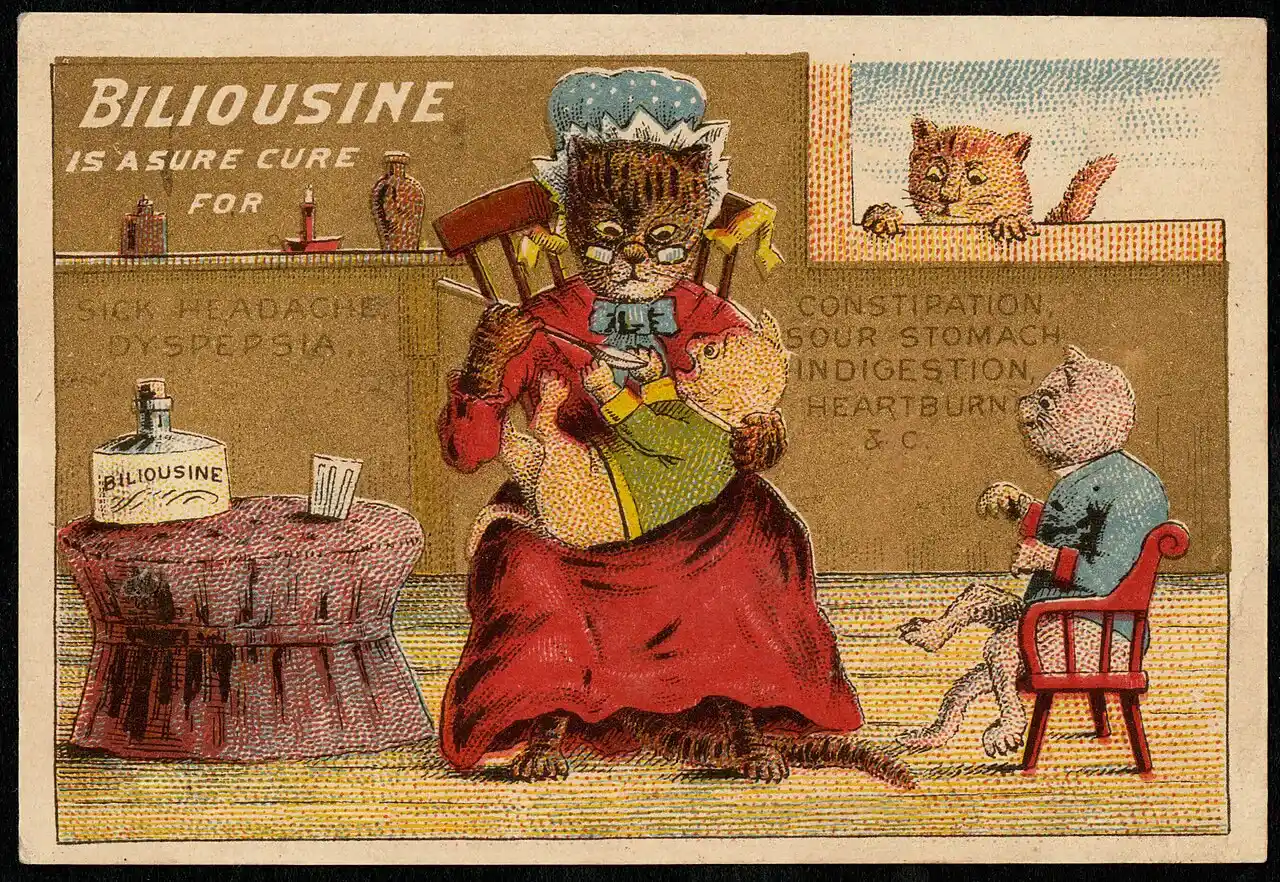
Not sure what Biliousine was but apparently it was the cats meow in snake oil medicines. Biliousine is a sure cure for sick headache, dyspepsia, constipation, sour stomach, indigestion, heartburn & ...
Explicit motor imagery
This is thinking about moving without actually moving. Your brain contains mirror neurons that fire when an person moves, when a person thinks about moving, and when that person watches another person move.
When you think about moving you use the same brain areas as you do when you actually move. This exercises your brain and prepares you for actual movement. It can be hard to think about moving body parts in pain.
This technique can help if you have altered sensory-motor areas. What does that mean? You have some sort of disconnect between your brain and the nerves (senses) from one or more body areas. Some examples: you have pain that is triggered by even the idea of movement and touch, you feel negatively towards your body part or feel like it doesn't belong to you, or your affected body part is swollen and stiff.
Mirror therapy (MT)
A mirror box is used to reflect your unaffected limb, and your painful limb is hidden behind the mirror. Basically, you are tricking your brain into thinking that your affected limb is being moved freely and normally. As you move your normal limb, you try to move your unseen affected limb in the same way but with smaller, controlled, and less scary (non-threatening) movements.
Graded motor imagery (GMI)
GMI has reduced pain severity for CRPS-1, limb pain after stroke, distal radius fracture, cancer, phantom limb pain, knee osteoarthritis, total knee arthroplasty (TKA), elbow stiffness, frozen shoulder, chronic shoulder pain, chronic rotator cuff-related shoulder pain (C-RCRSP) and more (Thieme et al. 2018, Zapparoli et al. 2020, Candiri et al. 2023, Sırlan et al. 2025).
Jan Josef Horemans the Elder - The Shoulder Operation between 1706 and 1759 oil on panel.

GMI exercises:
- 1) Right-left discrimination
- 2) Explicit motor imagery
- 3) Mirror therapy (MT)
Graded motor imagery (GMI) and Mirror therapy (MT) are proven interventions to help manage complex regional pain syndrome (CRPS). People had significant improvements in pain reduction, swelling reduction, and functional recovery (improvement doing tasks) (Donati et al. 2024).
These exercises attempt to correct brain changes associated with pain and with movement dysfunction. People with phantom pain, chronic pain, and complex regional pain syndrome (CRPS) have a less active or an altered sensorimotor cortex (Priganc and Stralka 2011). The sensorimotor cortex is the area of the brain involved in planning, controlling and executing movements.
GMT may work due to people paying attention to the affected area or limb; reducing people's fear of moving the painful area; facilitating cortical reorganization; and reorganizing sensorimotor incongruence. Sensorimotor integration is the ability of the brain to process sensory stimuli and translate that into motor actions (movement).
Max Beckmann Lady with a mirror 1943 oil on canvas.
 {{PD-US-expired}}_1_11zon.jpg)
Pain reprocessing therapy (PRT)
Sometimes your brain decides to organize itself so that you feel chronic pain. Why, you ask? Well often it is hard to know why. Maybe there once was a reason for the pain, maybe there is extra inflammation, maybe it is just Tuesday, no-one but your brain knows for sure and it isn't talking.
Could your pain actually be caused by your brain? This is true in many cases. There seems to be no physical reason for pain in 85% of people who suffer from chronic back pain (CBP) (discussion in Ashar et al. 2022). This doesn't mean that your pain is not real or that it hurts any less.
Most chronic pain comes from your brain thinking that normal messages sent from your nerves are dangerous. Chronic pain may be due to glia cell activation. Your brain becomes fearful and reacts to all stimuli, no matter how mild, as AGONY!!! PRT teaches your brain to perceive the pain and other signals sent to the brain as being less threatening. It changes beliefs about the cause and danger of pain.
During this treatment, therapists help people perform movements that normally cause them pain. At the same time, the therapist helps the patient re-evaluate the sensations they experience while they learn to manage the emotions that can make pain feel worse. For example, feeling scared or depressed can amplifying pain.
PRT Basic principles:
Most people believe that all pain is caused by damage or injury. Due to this fear, their brain starts to interpret harmless signals from the body as painful. This cycle can start for many reasons; inflammation, glial cell activation, temporary injury, sudden acute pain, or other reasons. Ironically, the use of opioid painkillers can cause chronic pain.
As pain transforms into chronic pain, it becomes more heavily associated with emotion-related brain circuitry. This includes the affective (fancy word for processing emotions) and motivational systems of the brain that are paired with avoidance. Chronic pain becomes less associated with the systems encoding nociceptive (pain) input (discussion in Hashmi et al. 2013, Ashar et al. 2022). In other words, chronic pain can be increasingly driven by emotions NOT by actual injury or by nerves signalling pain.
PRT teaches the person in pain to think of their pain as due to non dangerous brain activity instead of due to injury. People meet with a therapist who:
1) Provides evidence for centralized pain (pain caused by a dysfunction in the brain and/or nervous system)
2) Helped guide people through painful movements or postures while talking them through the process
3) Discussed the psychosocial threats such as negative emotions that can amplify pain
4) Taught people techniques to increase their positive emotions and self-compassion
In addition, people watched videos discussing how placebo treatments can relieve pain even when people know they are inert placebos. They received a saline injection as a placebo.
Does it work? In Ashar et al. 2022, a randomized study, 66% (33 out of 50 people) who completed 4-weeks of PRT were pain-free or nearly pain-free at posttreatment. In contrast, only 20% (10 out of 51 people) who had the placebo and 10% (5 of 50 people) who received usual care were pain-free after 4-weeks.
Pain neuroscience education (PNE)
PNE is a brain ( cognitive) intervention designed to reconceptualize a person's pain experiences. It reduces the ill effects of pain catastrophizing and kinesiophobia, the fear of movement (discussion Alcon and Wang-Price 2022).
One main principle of PNE is that chronic pain hogs up all your brain's attentional resources, leaving little space for other cognitively demanding tasks, like thinking critically or regulating emotions. The resulting cognitive dysfunction may limit a person's ability to evaluate, interpret, and revise the dysfunctional thoughts and irrational behaviors linked with catastrophizing and fear (discussion Alcon and Wang-Price 2022).
I, Susan, have lower back pain that I manage extremely effectively. My back first went out when I was an undergraduate in college. I had taken a bus trip across six states, slept on my aunt's floor for a few days, and than flew to my mom's place in Alaska. My first day there, I leaned over to pick up a fork and my back just gave out. I walked hunched over for a week and my friend called me grandma (if you are reading this, thanks Tasha, ha, ha!).
What worked for me was weight lifting and walking. Specifically I use exercises to target the lower and upper back and walk every day. Adding core exercises helped me even more.
Often chronic back pain is caused by a combination of weak and imbalanced muscles, fat build-up in the muscle and lower proprioceptive function. A low proprioceptive function is an impaired ability to sense the position and movement of the body. This leads to problems with balance and falling more.
Research shows that the combination of strength exercises and walking help improve lower back pain (discussion Lee and Kang 2016).
Other pain management therapies
★Physical pain therapies
Exercise and movement rewire your brain while decreasing inflammation. This decreases pain.
Exercise stimulates the brain to release brain-derived neurotrophic factor (BDNF); this is fertilizer for your brain. BDNF grows new neural connections and helps your nerves unlearn chronic pain patterns.
Movement teaches your body that nothing bad will happen if you move a body part. This is particularly useful if you have nebulous chronic pain in one area that seems to be spreading (back and shoulder pain are particularly susceptible to this pain creep).
People with chronic pain fear that moving will cause more pain. This leads to moving less and less. Basically, your body is trying to protect you by inhibiting use of an area it believes is injured (spoiler alert: the area is either not injured or was injured and now healed). This fear response triggers pain to keep you from moving the "injured" area. Gentle regular exercise retrains your brain, alleviates the fear and gradually stops the pain loop.
Can't exercise due to chronic fatigue or Long COVID? You can recover from exercise intolerance.
Activity can help heal by reducing inflammation.
★ Cognitive behavior therapy (CBT) for pain
Some main points of CBT:
1) Learn new ways to deal with pain. Focusing too much on pain can intensify a chronic pain loop.
When you concentrate on your pain your brain thinks, "Aha, this sensation is very important." Your brain is restructured to prioritize the pain sensation over other feelings. Nerve infrastructures dealing with pain are thickened and cross connected with different brain areas.
2) Learn HOW pain is processed by the brain. For example, your brain can decide how much pain to process at several points.
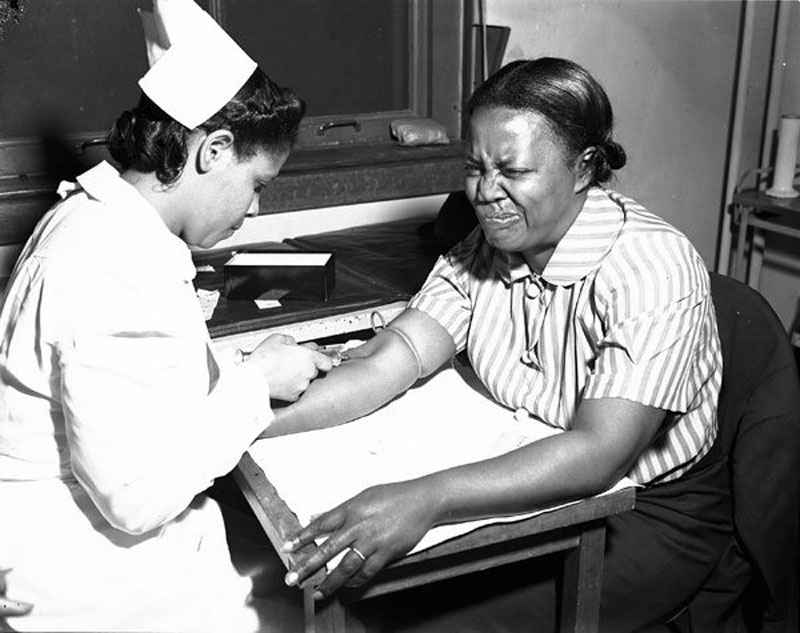
Nurse gives injection to woman, New Orleans, 1941.
3) Learn how emotions and thoughts influence pain. Negative emotions such as fear-avoidance may be a key factor in lower back pain. You fear pain and avoid activity which makes pain worse.
Catastrophizing (leaping to the worst conclusion) also leads to worse pain outcomes. It can change your brain.
For examples of the topics covered in CBT see Thorn 2020 and Alcon and Wang-Price 2022.
By Susan Fluegel PHD Nutritional Biochemistry
*People and their stories are real, but their names and some identifying details are changed.
I'm not your doctor; I'm just a person who would like to see you happy and healthy. If you have any questions about your pain or illness please consult a professional you trust.
References:
Alcon CA, Wang-Price S. Non-invasive brain stimulation and pain neuroscience education in the cognitive-affective treatment of chronic low back pain: Evidence and future directions. Front Pain Res (Lausanne). 2022 Nov 10;3:959609. doi: 10.3389/fpain.2022.959609. Full article.
Ashar YK, Gordon A, Schubiner H, Uipi C, Knight K, Anderson Z, Carlisle J, Polisky L, Geuter S, Flood TF, Kragel PA, Dimidjian S, Lumley MA, Wager TD. Effect of Pain Reprocessing Therapy vs Placebo and Usual Care for Patients With Chronic Back Pain: A Randomized Clinical Trial. JAMA Psychiatry. 2022 Jan 1;79(1):13-23. doi: 10.1001/jamapsychiatry.2021.2669. Full article.
Candiri B & Talu B & Karabicak G. Graded motor imagery in orthopedic and neurological rehabilitation: A systematic review of clinical studies: Graded motor imagery in rehabilitation. Journal of Surgery and Medicine. 2023. 7. 00-00. 10.28982/josam.7669. PDF.
Donati D, Boccolari P, Giorgi F, Berti L, Platano D, Tedeschi R. Breaking the Cycle of Pain: The Role of Graded Motor Imagery and Mirror Therapy in Complex Regional Pain Syndrome. Biomedicines. 2024 Sep 20;12(9):2140. doi: 10.3390/biomedicines12092140. Full article.
Gormley G, Brydges R. Difficulty with right-left discrimination: A clinical problem? CMAJ. 2016 Feb 2;188(2):98-99. doi: 10.1503/cmaj.150577. Full article.
Hashmi JA, Baliki MN, Huang L, Baria AT, Torbey S, Hermann KM, Schnitzer TJ, Apkarian AV. Shape shifting pain: chronification of back pain shifts brain representation from nociceptive to emotional circuits. Brain. 2013 Sep;136(Pt 9):2751-68. doi: 10.1093/brain/awt211. Full article.
Lee JS, Kang SJ. The effects of strength exercise and walking on lumbar function, pain level, and body composition in chronic back pain patients. J Exerc Rehabil. 2016 Oct 31;12(5):463-470. doi: 10.12965/jer.1632650.325. Full article.
Priganc VW, Stralka SW. Graded motor imagery. J Hand Ther. 2011 Apr-Jun;24(2):164-8; quiz 169. doi: 10.1016/j.jht.2010.11.002. Abstract.
Sırlan S, Alaca N, Yarar HA, Başcı O. Graded motor imagery as an adjunct to comprehensive physiotherapy in chronic rotator cuff-related pain: a single blind randomized controlled trial. BMC Musculoskelet Disord. 2025 Jul 3;26(1):588. doi: 10.1186/s12891-025-08783-w. Full article.
Thieme H, Morkisch N, Mehrholz J, Pohl M, Behrens J, Borgetto B, Dohle C. Mirror therapy for improving motor function after stroke. Cochrane Database Syst Rev. 2018 Jul 11;7(7):CD008449. doi: 10.1002/14651858.CD008449.pub3. Full article.
Thorn BE. Ronald Melzack Award Lecture: Putting the brain to work in cognitive behavioral therapy for chronic pain. Pain. 2020 Sep;161 Suppl 1(Suppl 1):S27-S35. doi: 10.1097/j.pain.0000000000001839. Full article.
Zapparoli L, Sacheli LM, Seghezzi S, Preti M, Stucovitz E, Negrini F, Pelosi C, Ursino N, Banfi G, Paulesu E. Motor imagery training speeds up gait recovery and decreases the risk of falls in patients submitted to total knee arthroplasty. Sci Rep. 2020 Jun 2;10(1):8917. doi: 10.1038/s41598-020-65820-5. Full article.